
An affiliate sends 500 people to an AI app. Another sends 80. The first partner looks more valuable on a dashboard that counts clicks and registrations. But suppose most of those 500 people wanted a free answer, while the smaller group arrived with a specific problem, used the product repeatedly, and bought a subscription. Which partner actually helped the business grow?
That question is central to affiliate marketing for AI products. Referral traffic is easy to count. The value of a referred customer takes longer to establish, especially when every serious interaction with the product can create a real serving cost.
For AI SaaS companies, a strong affiliate program is not a contest to collect the most sign-ups. It is a system for finding customers who activate, pay, and stay long enough for the relationship to work for the customer, the publisher, and the product company.
Why AI Affiliate Marketing Is Not Quite Ordinary SaaS Affiliate Marketing
The familiar affiliate model is simple: a partner recommends software, a visitor follows a link, and the software company rewards a conversion. AI products follow the same commercial pattern, but three characteristics make the economics harder to judge.
First, a registration is rarely evidence of value. A user may create an account, ask one question, and never return. A technical writer who signs up to test an API or a consultant who runs a real client workflow might be far more valuable, even if neither converts immediately.
Second, usage has a variable cost. Generative AI applications can incur charges for input tokens, output tokens, cached context, and other processing. The OpenAI API pricing documentation illustrates how those charges vary by model and workload. A referred user who generates thousands of responses without buying anything is not economically equivalent to a visitor who merely browses a software dashboard.
Third, revenue usually unfolds over time. Free trials, monthly plans, annual subscriptions, upgrades, downgrades, failed payments, and cancellations all change what a referral is worth. As Stripe explains in its MRR guidance, recurring revenue is a different measure from cash collected on a single invoice.
That means the useful question is not just who referred this customer? It is what happened to the customer after the referral?
Watch the video version of this article:
The Five Stages of an AI Affiliate Conversion
An affiliate program needs to distinguish five moments that are often mixed together in marketing reports:
- Discovery: Someone sees a useful explanation, tutorial, comparison, or recommendation and visits the product.
- Registration: The visitor creates an account or starts a trial. At this point, intent is still uncertain.
- Activation: The new user accomplishes a meaningful task – not merely opening the chat box or generating a novelty response.
- Paid conversion: A valid first payment is collected and associated with the referred customer.
- Retention: The customer renews, continues using the product, or expands the subscription.
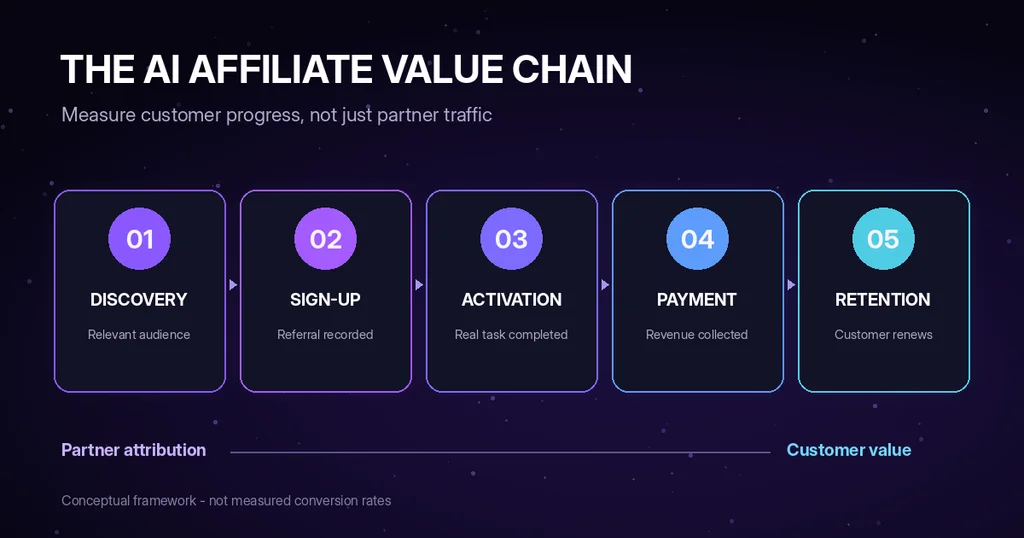
The activation step deserves particular attention. For an AI writing product it might be exporting a usable draft. For a research application it could be completing a source-backed investigation. For an AI coding service it might be successfully running a generated change. The exact event depends on the product, but it should represent a user receiving value, not simply consuming tokens.
A company that can identify this event has a better way to assess partners: which sources bring people who reach the product’s first meaningful outcome?
Track Referrals Beyond the First Click
The tracking challenge starts when a visitor moves from a partner’s content to a trial, and becomes more complicated when the same person returns later to subscribe.
Google Analytics documents separate first-user, session, and event-level attribution. These perspectives answer different questions. The channel behind the original discovery may not be the same channel associated with the final purchase session.
A sensible AI affiliate setup therefore connects the referral identity to an internal customer record at registration. When the customer later pays, renews, changes plan, or receives a refund, the system should reconcile that activity against the original attribution rather than assuming that a browser click equals revenue.
AI and SaaS companies use FirstPromoter to run affiliate programs, track referred sign-ups, and manage commissions on subscription revenue.
Even with dedicated software, the policy decisions remain the company’s responsibility. Before inviting partners, define:
- Attribution window: How long after a referral can a conversion be credited?
- Conversion trigger: Does a commission begin on trial registration, the first verified payment, or a later milestone?
- Renewals and changes: What happens to commissions when an account renews, upgrades, downgrades, pauses, or cancels?
- Refunds and disputes: When does a provisional commission become payable?
- Duplicate credit: What happens when a user encounters multiple partners before subscribing?
Subscription systems expose distinct billing events for successful invoices and subscription changes; Stripe’s event reference is a useful illustration of why these states should not be flattened into a single “conversion” label.
A Smaller Partner Can Produce More Recurring Revenue
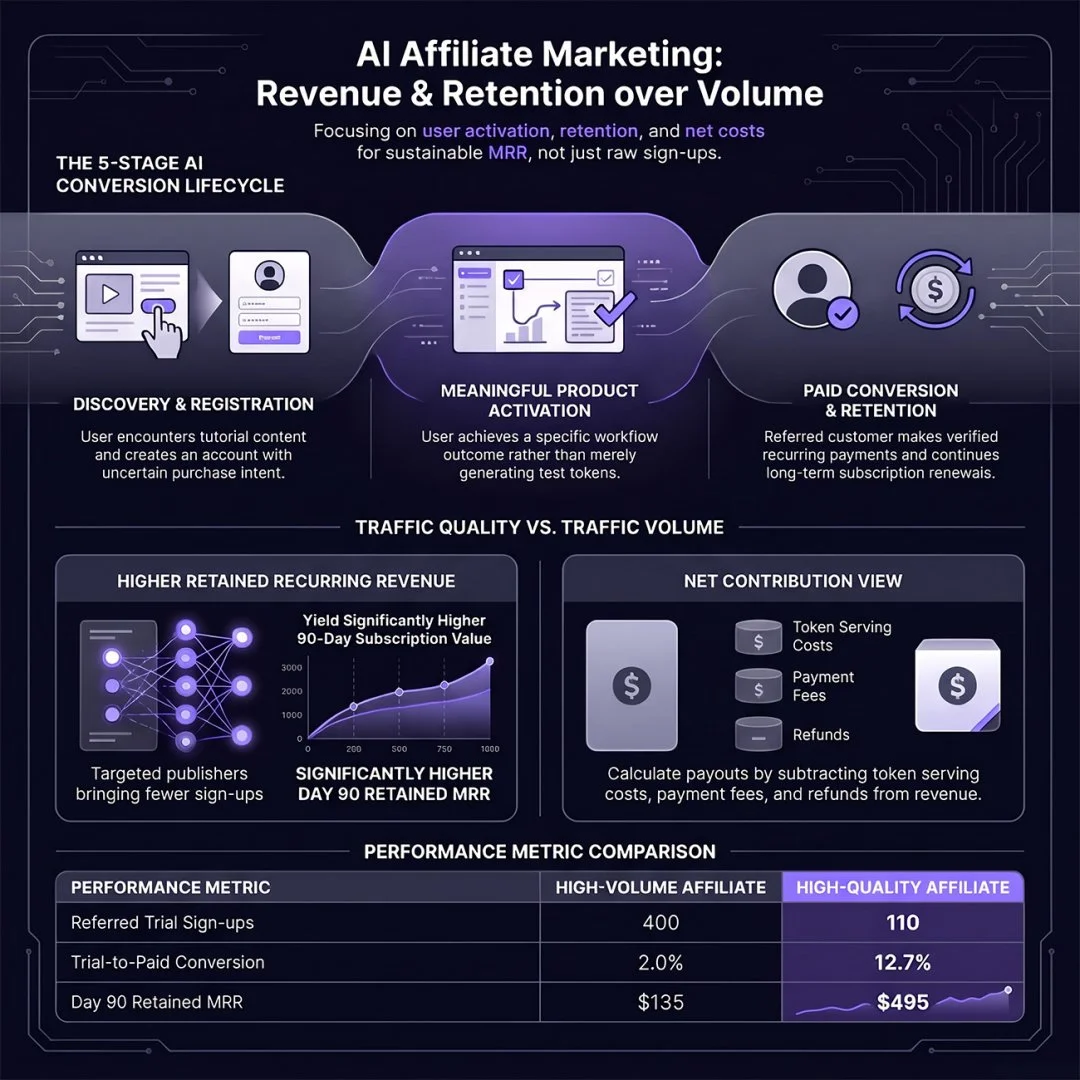
Consider two hypothetical affiliates promoting the same $45-per-month AI subscription. The numbers below are illustrative, not industry benchmarks or results from a live campaign.
| Metric | Affiliate A | Affiliate B |
| Referred trial sign-ups | 400 | 110 |
| Customers who make a first payment | 8 | 14 |
| Trial-to-paid conversion | 2.0% | 12.7% |
| Customers still paying at day 90 | 3 | 11 |
| Monthly recurring revenue from those retained customers | $135 | $495 |
Affiliate A is the apparent winner if the dashboard rewards registrations. Affiliate B brings more paying customers, better early retention, and over three times the remaining monthly recurring revenue in this example.
The lesson is not that small publishers always outperform large ones. It is that traffic quality can outweigh traffic quantity, and the difference is visible only when referral reporting reaches beyond the first conversion.
The economics should go one level further. Revenue is not contribution margin. For an AI product, a practical working calculation is:
Referred customer contribution = collected subscription revenue – AI serving costs – other variable service and payment costs – affiliate commissions – refunds.
This is a contribution view over a defined period, not a full company profit calculation. It deliberately excludes fixed engineering, general overhead, and any costs not assigned to the customer. Use actual billing and usage records rather than a headline plan price when evaluating it.
Choosing an Affiliate Commission Model for AI Subscriptions
No commission structure is universally best. The right one reflects trial quality, margins, payment timing, and how long customers tend to remain subscribed.
| Commission model | When it can work | Main risk to manage |
| Fixed bounty after first verified payment | Straightforward offers with predictable first-payment economics | The bounty can exceed the value of short-lived customers |
| Percentage of the first paid invoice | Products with clear paid conversion and variable plan prices | Encourages initial purchase more than retention |
| Recurring percentage for a limited period | Subscription products that want partners aligned with early retention | Margins can tighten during high-usage months |
| Ongoing recurring revenue share | Mature products with stable unit economics and durable partner relationships | Open-ended obligations may become expensive as product costs or pricing change |
For an early-stage AI product, a first-payment commission or a limited recurring period can be easier to budget than a permanent revenue share. A company with well-understood retention, plan-level margins, and reliable attribution might reasonably make a different choice.
One detail matters regardless of structure: pay against eligible collected revenue, not an estimated lifetime value. If the customer receives a refund or a free month, the commission policy should say exactly what happens.
The Best AI Affiliates Teach the Product, Not Just Promote It
AI products have a demonstration problem. Many look impressive in a screenshot. Far fewer are clearly differentiated until the user tries a specific workflow.
This makes certain affiliate formats especially useful:
- Workflow tutorials: Show a complete task, the starting material, the prompts or settings, and the finished outcome.
- Technical implementation guides: Help developers understand setup, integration limits, and realistic usage costs.
- Practitioner newsletters: Recommend products in the context of an audience’s recurring professional problem.
- Consultants and implementation partners: Introduce products while helping clients adopt a working process.
- Evidence-led reviews: Explain who benefits, where the product struggles, and what a buyer should test before paying.
The weak alternative is a generic list of “best AI tools” that repeats product taglines without testing anything. Such pages may attract curiosity clicks while sending visitors who never had a matching use case.
A useful partner brief should ask for one genuine outcome, the audience it serves, the prerequisites, and the limits. If the content would still help a reader who chooses not to buy, it is probably closer to good editorial work.
Disclosure, Accuracy, and Trust Are Part of the Program
Affiliate marketing creates a financial relationship between the publisher and the company being recommended. Readers should not have to investigate that relationship themselves.
The US Federal Trade Commission’s endorsement guidance calls for clear, conspicuous disclosure of material connections in endorsements, with the disclosure placed where readers will actually notice it. Local requirements can differ, so companies operating internationally should check the rules relevant to their markets.
AI products introduce another editorial responsibility: results can be prompt-dependent, model-dependent, and time-sensitive. A review should distinguish what was tested from what the product claims. A tutorial should not describe an experimental capability as generally available. A performance comparison should explain the conditions under which it was made.
For the company running the program, a simple review policy is often enough to prevent avoidable problems:
- Require partners to disclose compensation clearly.
- Prohibit invented testimonials, fabricated test results, and unsupported performance guarantees.
- Check brand usage and claims before distributing promotional assets.
- Recheck high-traffic tutorials when product capabilities or pricing change.
- Reserve the right to correct factual mistakes without forcing partners to publish predetermined praise.
These standards protect the publisher’s credibility as much as the software company’s reputation.
A Practical First-Month Launch Plan
An AI company does not need hundreds of affiliates to learn whether the channel can work. A carefully measured pilot is more informative than a large recruitment campaign with no reliable attribution.
Week 1 – Define the economics. Choose the activation event. Calculate variable cost by plan and user cohort. Decide what constitutes a commissionable payment, and document the refund and renewal rules.
Week 2 – Make attribution testable. Connect referral IDs to user records and billing events. Run controlled tests for a same-session payment, a delayed trial conversion, a renewal, a refund, and a canceled subscription. Confirm that the reported commission matches the payment ledger.
Week 3 – Recruit for audience fit. Start with a small set of educators, specialist publishers, technical writers, and consultants whose readers have a real reason to use the product. Provide documentation, a test account where appropriate, and factual background – not a prewritten glowing review.
Week 4 – Compare cohorts, not leaderboards. Assess partner-sourced registrations, first meaningful use, paid conversions, collected revenue, early retention, and variable serving costs. Hold off on major commission changes until cohorts have had enough time to develop.
A useful reporting view is one row per partner, with a consistent acquisition cohort and the same observation window for everyone. Comparing a mature three-month cohort with a partner recruited yesterday is not a fair performance test.
The Real Goal: An Audience That Stays
Affiliate marketing for AI products works best when it connects three kinds of value: a publisher gives its audience a genuinely useful recommendation, a customer gets a product that solves a recurring problem, and the AI company earns enough retained revenue to serve that customer sustainably.
Sign-ups are the beginning of that relationship, not the proof that it works. The strongest affiliate program is the one that can trace a recommendation all the way to meaningful use, a legitimate payment, and a customer who wants to keep coming back.
For AI SaaS, retention is not a secondary marketing metric. It is what turns a referral into a business.