All Claude prices in one place: every subscription plan from Free at $0
to Max 20x at $200/month, Team and Enterprise seats, and what Claude Code, Cowork and the API cost on each. Updated every two weeks,
or the day Anthropic changes something.
Below: the full price table, the usage limits, and the complete API rate card.
Pricing Claude against the other AI subscriptions you are paying for? Suprmind runs Claude, GPT, Gemini and Grok in one conversation from $19 a month, which is less than a single Claude Pro seat. See how the plans compare.
Suprmind Frontier is $95 a month for five frontier models
in one thread.
Claude Max 5x is $100 a month for one.
Claude costs from $0 to $200 per month for individuals, with per-seat business plans on top. The free tier runs Claude Sonnet 5 with usage limits. Paid consumer plans are Pro at $20/month, Max 5x at $100/month, and Max 20x at $200/month. Business plans are Team Standard at $25/seat, Team Premium at $125/seat, and Enterprise from $20/seat plus usage. The current flagship API model, Opus 5, is $5 per million input tokens and $25 per million output.
Claude is built by Anthropic, so Anthropic pricing and Claude pricing are the same list. Both names lead to the same plans, seats, and API rates covered on this page.
Full breakdown of each tier, the usage-limit opacity, and the complete API rate table below.
Claude Free is the $0 baseline. Pro moves to $20/month and adds Claude Code, higher usage, Research mode, unlimited Projects and paid-plan integrations. Max 5x jumps to $100/month for substantially more capacity, while Max 20x costs $200/month for the highest consumer usage limits.
If you need Claude Code but rarely hit limits, Pro is the value tier. If Pro limits interrupt daily work, Max 5x is the next step. Max 20x is aimed at all-day Claude Code, parallel sessions and workloads where weekly caps become the bottleneck.
Compare monthly prices, model access and usage capacity before choosing which setup fits your work.
Compare Suprmind Plans & Pricing →See current plan prices, included models, modes and usage limits.
The Free tier costs nothing and, since June 30, 2026, defaults to Claude Sonnet 5 – the same mid-tier model that runs on Pro. Usage caps are described as a rolling budget rather than a message count. Anthropic does not publish an exact figure for any tier. You get a warning as you approach the limit, then a message naming the reset time. Sessions reset within about five hours.
Claude Free is a permanent $0 subscription tier and the baseline for comparing the paid plans. It already includes Sonnet 5, so the main reasons to move to Pro are Claude Code, higher usage, Research mode, unlimited Projects and paid-plan integrations.
Getting Sonnet 5 on the free plan is a real change from the old picture, where Free ran an older Sonnet. For casual queries and exploratory work, Free is now a capable tool. For any work where citation accuracy matters, turn on web search before relying on a response, and cross-check anything consequential. Claude’s Sonnet-tier models have historically posted lower hallucination rates than several peers per Suprmind’s AI Hallucination Rates and Benchmarks reference, but no single model catches its own blind spots.
Click Start (not a video) to see how Suprmind orchestrates Claude and four other frontier AIs in the same conversation. They read each other’s responses, argue, disagree, and build on each other’s ideas – so you get a polished, pressure-tested answer that no single model could produce on its own.
To start an interactive Suprmind demo, click the ▶ and the demo will start on this page.
You can scroll down whenever you want, and simply scroll back to return to the demo.
It will wait for you.
Pro is $20/month, or $17/month billed annually ($200 up front). It runs Sonnet 5 by default with access to more Claude models, more usage than Free, Research mode, unlimited Projects, voice mode, and Microsoft 365 integration. Annual billing cuts the effective rate about 15%.
Earlier in 2026, reporting conflicted on whether Claude Code was included in Pro. The current pricing page settles it: Pro includes Claude Code, Claude Cowork, Claude Design, and Claude Science. What has stayed in flux is programmatic usage – the Agent SDK and headless scripts – which Anthropic proposed to split into a separate credit, then paused. That story sits in the usage-limits section below.
The practical comparison is Claude Free versus Pro at $20/month. Pro becomes worthwhile when you need Claude Code, higher usage, Research mode or Projects without the tighter Free-tier limits. If those limits still interrupt daily work, the decision shifts from Pro to Max rather than from Free to Pro.
Pro is the most common upgrade path. The clearest signals you need it: you are getting rate-limited mid-conversation on Free, you want Claude Code in the terminal, or you use Projects to organize work. If you do not hit limits regularly, Free now covers a lot, since it runs the same default model.
See also: Claude Code feature deep dive →
The Claude Max plan sits at the top of the consumer subscription ladder. Both variants run the same model lineup as Pro plus higher output limits, early access to new features, and priority routing at high-traffic times. The difference is capacity: Max 5x gives 5x Pro’s usage, Max 20x gives 20x. The Max plan is monthly only. There is no annual discount on either variant.
The choice is about which cap binds first. If the five-hour session limit stops you, Max 5x usually fixes it. If the weekly cap is the wall, Max 20x raises it but does not remove it: sustained parallel-agent work can still exhaust a week in two or three days, which is why some power users run more than one Max account or overflow into usage credits at API rates.
Anthropic no longer publishes exact message or hour counts, so the honest test is to run a few representative days and watch where you hit the ceiling.
Claude Code has no standalone price. There are two ways to pay for it. Route one is a Claude subscription: Pro at $20/month, Max 5x at $100, Max 20x at $200, any Team seat, or Enterprise, where terminal work draws from the same usage pool as your chats. Pricing route two is pay-as-you-go: point Claude Code at a Claude Platform API key and every token is metered at standard API rates, with no session or weekly caps, and no ceiling on the bill either.
Every Claude subscription meters Claude Code against two stacked caps: a rolling five-hour session window and a weekly ceiling on top, shared with everything else you do on the plan, chat included. When Anthropic doubled the five-hour limits on May 6, 2026, the weekly cap did not move. That is the trap for heavy users: burst hard for two or three days and the week is gone while the session meter still shows headroom.
When a cap hits, you have three options: wait for the reset, upgrade, or enable usage credits to keep working at API rates.
The API, as a Claude Code pricing choice, removes every cap and replaces them with a bill. Independent trackers put typical spend at $30 to $60/month for light use, $150 to $300 for professional daily use, and $450 to $900 for full-time heavy loads, with a five-developer team landing between $1,500 and $3,000. Those are third-party estimates, not Anthropic figures, and workflow discipline moves them a lot.
Prompt caching is the biggest lever: Claude Code re-sends its fixed overhead on every turn, and cached reads cost 90% less than fresh input. Batch processing halves every rate for non-interactive jobs.
See also: Claude Code feature deep dive →
Claude Cowork, the desktop agent for non-developers, has no separate price and no alternative billing route. It is included in Pro at $20/month, both Max tiers, every Team seat, and Enterprise, and it draws from the same usage pool as chat and Claude Code. The Free tier does not include it. If Cowork is the reason you are upgrading, Pro at $17/month on annual billing is the cheapest way in.

The Claude Team plan is for organizations that need shared Projects and admin tooling but not full enterprise compliance infrastructure. For most companies this is the Claude for business entry point, with Enterprise above it. You can mix standard and premium seats on one account, assigning premium seats to your heaviest users. Team starts at two seats and tops out at 150. Beyond that, Anthropic routes you to Enterprise.
Every Team seat includes Claude Code and Cowork, central billing, SSO, admin controls for connectors, and no model training on your content by default. A ten-person team on premium seats runs $1,000/month on annual billing or $1,250 monthly. Standard and premium seats live on the same plan, so you do not have to pick one rate for the whole org.
Enterprise starts at $20/seat and adds usage that scales with model and task, billed at API rates. It is annual only. It adds the governance layer that Team does not carry: role-based access with fine-grained permissioning, SCIM provisioning, audit logs, a Compliance API for observability, custom data retention controls, network-level access control, IP allowlisting, an available HIPAA-ready offering, and Claude Security in beta.
Anthropic’s enterprise pricing has two paths. A self-serve tier lets you start today without contacting sales. A sales-assisted tier carries a Master Service Agreement, tiered incentives on committed spend, non-standard terms, and customer success support at certain spend thresholds. Anthropic uses FastSpring as merchant of record for consumer plans, which matters for procurement and invoicing on smaller buys.
The structural difference from Free, Pro, and Max: Enterprise and Team exclude your content from model training at the contract level, with no per-user opt-out to manage. On the individual plans, training is opt-out by default, so each user has to turn it off themselves.
See also: Suprmind Multi-Model Divergence Index →
Unlike some competitors, Claude is transparent about which model you get – you pick it, and the model selector shows it. The opacity sits elsewhere. Anthropic does not publish message-per-period or hour counts for any consumer tier. The pricing page says only that usage limits apply and points to a best-practices article. Two subscribers on the same subscription tier can hit their ceiling at different points depending on model choice, message length, and time of day.
claude -p command, GitHub Actions, and third-party agent apps – would split into a separate monthly credit on June 15. On June 15, it paused the change. For now, programmatic and interactive usage still draw from the same subscription pool, and Anthropic has said a revised version may return with advance notice.If your workflow depends on predictable throughput, or on knowing exactly what a plan gives you, the API removes the ambiguity. It is metered, has no session or weekly caps, and bills per token – at the cost of managing spend yourself. For interactive work, subscriptions still win on price by a wide margin.
If your decision is between a heavier Claude subscription and a multi-AI subscription, compare model access, usage capacity and workflow features side by side.
Compare Suprmind Pricing →See current monthly plans and included model access.
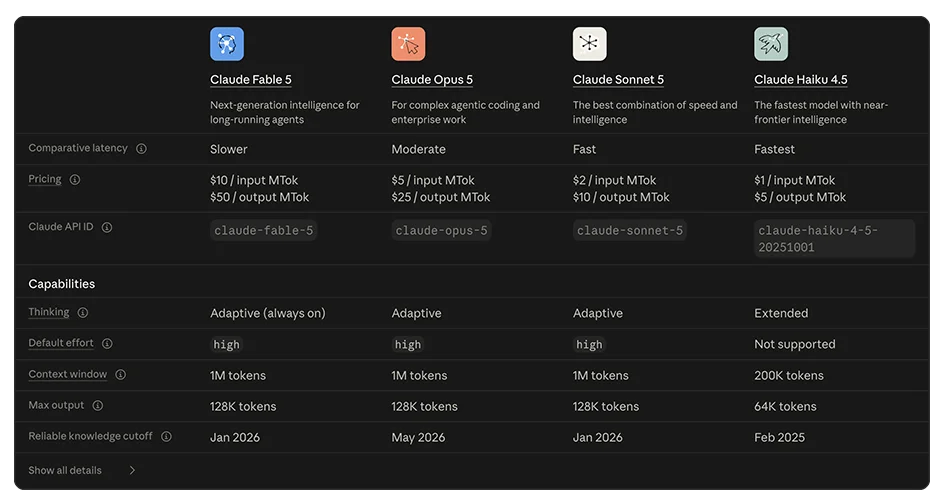
API pricing is metered per million tokens, with separate input, cached-write, cached-read, and output rates. Cached reads run 90% cheaper than fresh input – a real saving for stable system prompts and templated requests. The four current models sit above a set of still-callable legacy models.
Sonnet 5 ships at an introductory $2/$10 per million tokens through August 31, 2026, then moves to $3/$15 – the same rate Sonnet has always carried. Fable 5 is the generally available Mythos-class model, sitting above Opus with always-on adaptive thinking and safety classifiers that fall back to Opus 5 for flagged requests. Opus 5 (May 28, 2026) shifted the emphasis toward reliability – Anthropic reports it is roughly four times less likely than Opus 4.7 to let flaws in code it wrote pass unremarked.
Rates change, so verify at claude.com/pricing before budgeting.
Sonnet 5 uses a new tokenizer that produces roughly 1.0 to 1.35x more tokens than Sonnet 4.6 for the same text. The headline introductory rate is $2/$10 per million tokens, but because the same English content now maps to more tokens, the effective cost per unit of actual text runs higher – independent testing puts it near $2.84/$14.20 per million tokens of English content.
Anthropic frames the introductory discount as keeping migration from Sonnet 4.6 roughly cost-neutral, which is itself a signal that token-for-token, Sonnet 5 costs more to run.
Budget on measured token counts from your own workload, not the sticker rate. The tokenizer bump hits English, Spanish, and code harder than Chinese.
Prior models remain available for pinned integrations. Opus 4.1 is the outlier at $15/$75 – the price point that the February 2026 Opus 4.6 launch cut by 67% and that every Opus release since has held at $5/$25.
Source: claude.com/pricing, accessed July 7, 2026. On June 15, 2026, the original Claude 4 snapshots (claude-sonnet-4 and claude-opus-4 from May 2025) stopped accepting requests. Migrate pinned slugs and recheck cost projections.
Batch API halves every model rate for async work processed within 24 hours: Opus 5 drops to $2.50/$12.50, Sonnet 5 to $1/$5 at the intro rate, Haiku to $0.50/$2.50. It is the right path for high-volume, non-interactive jobs where 24-hour latency is acceptable. Service tiers – Priority, Standard, and Batch – let you trade availability against predictable cost.
Per the Suprmind Multi-Model Divergence Index (April 2026, n=1,324 production turns), Claude’s catch ratio is 2.25 – it caught 304 errors made by other models and was caught 135 times. Combined with Perplexity (catch ratio 2.54), the two providers account for 60.7% of all corrections in the study. For verification-layer workflows where catching errors matters more than answering breadth, Claude at $5/$25 (Opus 5) or $3/$15 (Sonnet 5 standard) is competitive with peer pricing despite not being the cheapest option.
See also: AI catch ratio data →
Suprmind puts Claude beside GPT, Gemini, Grok and Perplexity in the same workspace, with orchestration, comparison and shared context across models.
See Suprmind Plans & Pricing →Compare plan prices, model access and usage capacity.
Both the API and claude.ai cover all EU member states, the UK, US, Canada, Australia, Japan, India, South Korea, Brazil, most of Africa, the Middle East, and Southeast Asia. Russia, mainland China, North Korea, Iran, Cuba, Belarus, and the occupied Ukrainian territories are not supported.
See also: Suprmind’s AI Hallucination Rates and Benchmarks reference →
The pattern holds: falling or flat prices on flagship reasoning, a new tier added above Opus, and usage limits that keep moving. The February 2026 Opus cut reset the Opus rate at $5/$25, and every Opus release since has stayed there. Consumer plan prices have not changed across the whole window.
Claude pricing explained in seven minutes — also on its dedicated watch page.
Source: claude.com/pricing, September 2026. “Limited” Opus and Fable access on Pro means availability with tighter usage caps than Max and above.
On paid plans, context size depends on the model and the surface, not the plan tier. The headline 1M window applies to Sonnet 5 in chat. Opus runs at half that in the chat interface and only reaches 1M inside Claude Code. This is the fine print that decides whether a plan fits long-document work.
* Pro requires usage credits enabled to reach 1M on Opus models. ** Usage credits required, except on usage-based Enterprise plans. On paid plans with code execution enabled, Claude also summarizes earlier messages automatically as a conversation nears the limit, so long chats can continue without a hard wall in most cases. The Free tier is not covered by these figures. Source: Claude Help Center, updated July 2026.
FAQ
Claude Pro is the cheapest paid individual plan at $20/month, or $200/year when billed annually – an effective $17/month. It adds Claude Code, higher usage, Research mode, unlimited Projects and other paid-plan features over the $0 Free tier.
Yes. The Free tier at $0 defaults to Claude Sonnet 5 – the same mid-tier model that runs on Pro – with usage limits described as a rolling budget rather than a message count. Free includes web search, memory, Artifacts, file creation, code execution, and connectors. Claude Code, Opus 5, Fable 5, and Research mode require a paid tier.
Yes. Claude Pro is $20 month-to-month or $200 billed annually, which works out to about $17/month. Annual billing saves roughly 15% compared with paying monthly for a full year.
$0 on Free, $20 on Pro ($17/month billed annually), $100 on Max 5x, and $200 on Max 20x. Team seats run $25 to $125 per person per month, and Enterprise starts at $20/seat plus usage billed at API rates. The API itself has no monthly fee. It is metered per token.
Pro is $20/month, or $17/month billed annually ($200 up front). It includes Sonnet 5 by default, access to more Claude models, Research mode, unlimited Projects, voice mode, Microsoft 365 integration, and Claude Code, Cowork, Design, and Science. The Claude Code question that was contested earlier in 2026 is settled: the current pricing page lists it as included in Pro.
Five named subscription plans at seven price points: Free ($0), Pro ($20/month), Max 5x ($100), Max 20x ($200), Team with Standard ($25/seat) and Premium ($125/seat) seats, and Enterprise (from $20/seat plus usage). Every paid subscription includes Claude Code and Claude Cowork.
Anthropic does not sell a plan called Claude Premium. Searches for a premium tier usually mean one of two things: Pro at $20/month, the cheapest paid subscription, or the Team Premium seat at $125/seat/month, which carries 5x the usage of a standard Team seat.
Max comes in two variants: Max 5x at $100/month (5x Pro usage) and Max 20x at $200/month (20x Pro usage). Both run the same models plus higher output limits and priority access. Max is monthly only – no annual discount. Max 20x is the top consumer tier for heavy Claude Code and parallel-agent work, though the weekly cap still applies and sustained loads can reach it.
Team Standard is $25/seat/month ($20 annually) and includes all Claude features with more usage than Pro, SSO, and admin controls. Team Premium is $125/seat/month ($100 annually) and carries 5x the usage of standard seats with the same feature set. You can mix both seat types on one account. Team covers teams of 2 to 150 seats.
Sonnet 5 launched June 30, 2026 and is now the default model on Free and Pro. Anthropic positions it as its most agentic Sonnet, performing close to Opus 5 at lower cost. API pricing is an introductory $2/$10 per million tokens through August 31, 2026, then $3/$15. Note that Sonnet 5 uses a new tokenizer that produces roughly 1.0 to 1.35x more tokens per input than Sonnet 4.6, so the effective cost per unit of text runs higher than the sticker rate.
Fable 5 is the generally available Mythos-class model, a tier Anthropic added above Opus in June 2026. It runs always-on adaptive thinking, a 1M context window, and safety classifiers that fall back to Opus 5 for flagged requests in areas like cybersecurity and biology. API pricing is $10/$50 per million tokens. Mythos 5 is the same model without the classifiers. After the June export-control episode, Fable 5 returned globally on July 1, while Mythos 5 is being reintroduced only to approved US organizations through Project Glasswing.
It depends on the model and the surface. When chatting on a paid plan, Sonnet 5 has a 1M window, Opus 5, 4.7, 4.6 and Sonnet 4.6 have 500K, and all other models including Haiku 4.5 have 200K. In Claude Code, Sonnet 5, Fable 5, and the Opus 4.x models reach 1M, though Pro users must enable usage credits to hit 1M on Opus. With code execution on, Claude also summarizes earlier messages automatically as the window fills, so long chats rarely hit a hard wall.
The four current models, per million input/output tokens: Fable 5 at $10/$50, Opus 5 at $5/$25, Sonnet 5 at $2/$10 (introductory through Aug 31, then $3/$15), and Haiku 4.5 at $1/$5. Cached reads run 90% cheaper than fresh input. Batch processing halves every rate. Legacy models remain callable, with Opus 4.1 the outlier at $15/$75.
Nothing on top of a paid plan, or per token if you go direct. Claude Code is included in Pro ($20/month), Max 5x ($100), Max 20x ($200), every Team seat, and Enterprise, drawing from the same usage pool as chat. It also runs on a Claude Platform API key at standard per-token rates with no session caps, which independent trackers estimate at $150 to $300/month for professional daily use and $450 to $900 for heavy full-time loads. It is not available on Free.
No. Max 5x and Max 20x raise the ceilings but keep the same two-layer structure: a rolling five-hour session window plus a weekly cap, and the weekly cap did not grow when Anthropic doubled session limits in May 2026. Sustained all-day agent work can exhaust a weekly allowance in two to three days even on Max 20x. Past the cap you wait for the reset, upgrade, or enable usage credits billed at API rates.
Anthropic describes limits as a rolling budget rather than a fixed message or hour count, and points to a best-practices article instead of publishing numbers. The limits also moved several times in 2026 – doubled on May 6, raised 50% on May 13 through July 13. Two users on the same plan can hit their ceiling at different points depending on model, message length, and time of day. For predictable throughput, the metered API has no caps.
On May 14, 2026, Anthropic announced that programmatic usage (the Agent SDK, headless claude -p, GitHub Actions, third-party agent apps) would split into a separate monthly credit on June 15. On June 15, it paused the change. For now, programmatic and interactive usage still draw from the same subscription pool, and Anthropic has said a revised version may return with advance notice. Interactive terminal use of Claude Code was never affected.
Pro is $17/month billed annually ($200 up front) versus $20 monthly. Team Standard is $20/seat annual versus $25 monthly. Team Premium is $100/seat annual versus $125 monthly. Max 5x and Max 20x are monthly only – no annual discount. Enterprise is annual only.
Settings, then Privacy, then Data Usage – toggle off training consent. Anthropic changed from opt-in to opt-out by default in August 2025, extending retention to five years for users who do not opt out. Team and Enterprise exclude training at the contract level with no per-user opt-out to manage.
Anthropic offers institution-wide education plans covering students, faculty, and staff, with academic research and learning modes and dedicated API credits. Individual student discounts are not publicly listed. Verify current options on Anthropic’s education page.
No. Anthropic is the company and Claude is the product, and one price list covers both names. Anthropic pricing, Claude pricing, and claude.com/pricing all describe the same subscription plans and API rates listed on this page.
Last verified September 2026. Rates and limits change without notice – confirm at claude.com/pricing before making decisions.
Compare Suprmind plans with Claude Pro and Max based on model access, usage capacity and the way you actually work.
Compare Plans & Pricing →Claude, GPT, Gemini, Grok and Perplexity in one multi-AI workspace.
Disagreement is the feature.
Last verified September 2026. Next refresh due December 2026.


