
Threat assessment decisions can change a person’s job, safety, or freedom. When you add a language model to the process, one confident answer can quietly influence the final choice. Consider what might happen when five different models review the same hypothetical incident, and why handling their disagreements matters in high-stakes decisions.
Why one model isn’t enough for threat assessment
Behavioral threat assessment involves a structured, multidisciplinary process. Teams evaluate concerning communications, context, behavioral history, and protective factors before deciding whether to monitor a situation, intervene, or take no further action. A false positive can unfairly stigmatize an employee, while a false negative can leave a genuine safety concern unaddressed. That much responsibility should not rest on an AI model alone. Models can make errors influenced by their training data, design, and evaluation methods.
One way to explore different interpretations is to present the same verified facts to multiple models. However, agreement among models does not establish accuracy, and multiple models can share the same blind spots. This multi LLMs guide explains how orchestration tools can submit prompts to multiple models and organize their responses for comparison.
The incident: A composite case
This is a made-up story, not a true event. Late at night, an employee posts in an internal chat channel that a coworker “will regret” a recent review of their work. There are no documented prior threats in this scenario. The employee recently lost a family member, and their access to weapons is unknown. When HR escalates the message for assessment, imagine that the team gives five different AI models the same structured questions and facts.
What the five models returned
In this illustrative exercise, two models classify the apparent risk as low and interpret the message as an expression of frustration. Two others recommend a supportive welfare check and a conversation with a supervisor without assigning a firm risk rating. A fifth model flags the language as ambiguous and declines to rate the situation without additional information. These are hypothetical responses, not verified outputs from an actual five-model test.
The disagreement is useful because it reveals questions the team still needs to investigate, not because any model has established the correct level of risk.
When you understand how conversational AI works, that spread doesn’t come as a surprise. Language models generate responses from learned patterns, and their outputs can vary with prompt wording, context, and model configuration. Disagreement may highlight competing interpretations, but it is not, by itself, a reliable measure of uncertainty or accuracy.
How the team resolved it
In the hypothetical review, the team does not average the models’ responses or treat them as a vote. A qualified threat assessment professional examines the available evidence, identifies missing information, and reviews the assumptions in each response. The two low-risk interpretations do not explicitly address the employee’s recent bereavement. However, bereavement alone does not establish a risk of violence.
After applying the organization’s threat assessment procedures and checking for immediate safety concerns, the team could consider having a supportive conversation with the employee rather than immediately pursuing disciplinary action. That choice would depend on verified facts and professional judgment, not the models’ recommendations alone. The decision record should identify the evidence reviewed, the unresolved questions, the rationale for any intervention, and the people responsible for the decision.
Turning disagreement into a documented decision
Consensus is not the goal. The goal is a defensible record of how the team reached its conclusion. For high-stakes AI-assisted decisions, three elements matter: the verified information provided to each model, the explanations and limitations in the models’ responses, and the independent human judgment used to resolve the case. Model-generated explanations should be treated as statements to evaluate, not as definitive accounts of how a model internally arrived at its answer.
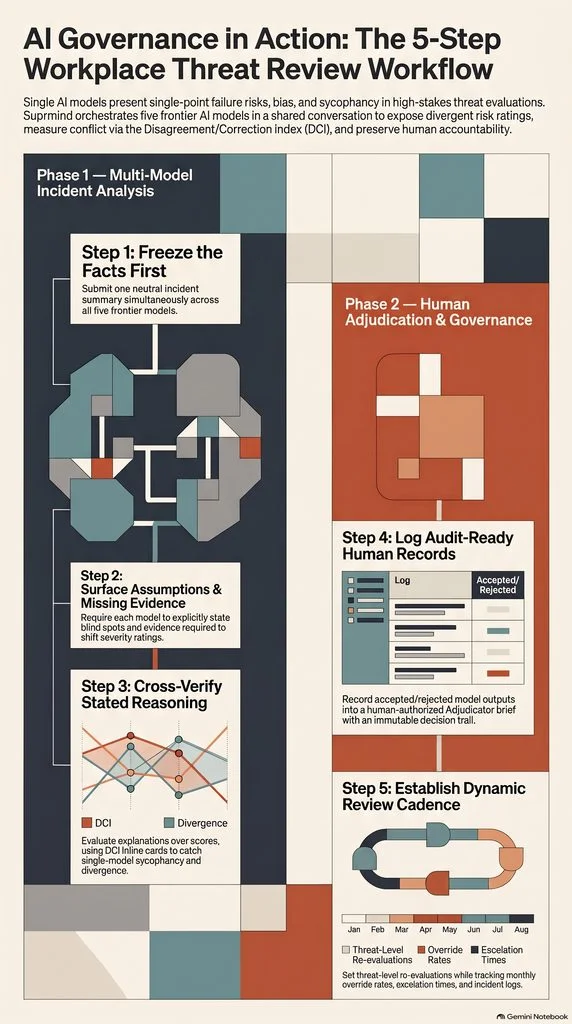
A five-step review workflow
- Freeze the facts first: Write one neutral summary of the event and give each model the same text. Record the sources, prompt, model versions, and relevant settings. This reduces input-related differences, although outputs may still vary because of model behavior and configuration.
- Identify assumptions and missing evidence: Ask each model to state its assumptions, identify missing information, and describe evidence that could change its assessment. Verify these claims independently rather than treating the responses as proof.
- Review explanations, not just scores: Two models can assign the same risk rating for different stated reasons. Review those explanations critically and avoid treating unvalidated model scores as established measures of violence risk.
- Record the disagreement and decision: Document which interpretations were accepted, rejected, or left unresolved, along with the supporting evidence and the authorized human decision-maker. Good documentation supports accountability, but it does not automatically make a decision legally defensible.
- Schedule a follow-up review: Set a review date based on the severity of the concern, any new evidence, and organizational procedures. A 30-day review may suit some situations but is not a universal standard. Evaluate model performance using appropriate validated criteria rather than assuming that later events reveal which model was correct..
When things are urgent, teams may feel pressure to reach a conclusion quickly. This breakdown of how AI makes decisions discusses the risks of overreliance on fast, confident-looking outputs. A structured review can help teams examine uncertainty, but urgent safety concerns must follow established escalation procedures rather than wait for additional model comparisons.
Oversight frameworks that hold up
It’s not enough to just compare outputs. The U.S. National Institute of Standards and Technology’s AI Risk Management Framework (NIST AI RMF), ISO/IEC 42001:2023, and the European Union’s AI Act offer different approaches to governing AI risks. NIST provides voluntary risk-management guidance, ISO/IEC 42001 specifies requirements for an organizational AI management system, and the EU AI Act establishes binding obligations according to an AI system’s classification and use.
These frameworks can inform approval processes, documentation, human oversight, and escalation procedures. However, their requirements are not interchangeable, and the legal obligations depend on the jurisdiction and intended use. Assign clear responsibilities to qualified people with the authority to challenge AI outputs and make or escalate consequential decisions.
The review rhythm is also important. A quarterly review alone may be insufficient for high-impact applications. As a practical governance measure, teams can review human override rates, escalation times, and incident logs monthly, while updating controls promptly when significant issues arise. The appropriate frequency should reflect actual risk and applicable requirements.
What recent research says
Human overrides aren’t noise
A June 19, 2026, World Economic Forum article discussed a real-world study of 32,501 CT pulmonary angiograms published in Radiology: Artificial Intelligence in May 2026. The AI tool and radiologists agreed on 97.8% of examinations. Among the cases in which they disagreed, expert adjudicators found that the radiologists were correct 88.7% of the time.
The finding highlights the potential value of qualified human review in that particular medical setting. It does not establish that human overrides are usually correct in workplace threat assessment or that multiple language models improve threat classification.
Accountability is a social question
The same World Economic Forum article argues that some organizational leaders approach AI oversight mainly as a technology procurement and compliance exercise, rather than investing sufficiently in human judgment. This is the author’s interpretation, not a quantified finding from the radiology study.
AI legislation also increasingly addresses human oversight and organizational responsibilities. South Korea’s AI Basic Act took effect on January 22, 2026, establishing requirements for certain high-impact AI applications. Vietnam’s Law on Artificial Intelligence took effect on March 1, 2026, and includes provisions addressing human oversight and intervention, as well as the obligations of providers and deployers. The precise duties vary by jurisdiction, system classification, and applicable transitional provisions.
The broader lesson is that accountability cannot be delegated entirely to software. Organizations must establish who can question an output, who can authorize action, and, where applicable, how affected people can challenge consequential decisions. A documented decision is important, but documentation alone does not establish that the decision was correct or lawful.
Expert tips for threat teams
Good habits make it easier to apply a consistent review process, and defensible AI decisions depend on them. Use the following tips as a starting point.
- Assign competing review roles: Ask one model to identify evidence supporting a lower-risk interpretation, another to identify evidence supporting a higher-risk interpretation, and a third to critique both. Use these perspectives to generate questions for qualified reviewers, not to establish an objective risk score.
- Monitor human override patterns: Unusually low or high override rates may warrant a review of whether oversight is meaningful. Neither rate proves that human reviewers or AI systems are performing well. Examine the underlying decisions and outcomes.
- Assess the costs of errors: Unnecessary investigations can consume resources, damage trust, and create legal risks, while missed threats can endanger people. Consider both types of harm without reducing safety decisions to financial calculations alone.
- Test for bias: Use controlled, synthetic scenarios to examine whether irrelevant changes in names, dialects, or cultural references affect model recommendations. Keep the underlying meaning consistent, since linguistic changes may also alter the context. Test outcomes across groups where lawful and appropriate, and have qualified reviewers assess potential bias.
- Restrict access to sensitive outputs: Limit access to raw model responses, personal information, and decision records to legitimate roles and in accordance with applicable privacy requirements. Share only the information necessary for authorized action, and apply appropriate retention and deletion rules.
Just as important as research is the documentation. This article about the best AI for writing research papers illustrates a general workflow in which one model drafts material and another reviews it. The approach may help organize document review, but it is not evidence that model cross-checking is sufficient for high-stakes threat assessment.
Building skills and choosing tools
If you want to get formal training in this area, the Research.com comparison of AI master’s programs for governance careers is a starting point for exploring programs related to AI risk, policy, ethics, and technical oversight. Confirm course content, accreditation, costs, and current offerings directly with each institution before enrolling.
Start your search for a platform by looking at the features of an AI decision making software: audit logs, side-by-side model outputs, role-based access, and records that can be exported. For enterprise AI oversight, also assess data protection, vendor permissions, retention controls, model-version tracking, and whether the system is appropriate for the intended high-stakes use.
Limits and safe use
This article discusses a hypothetical composite scenario and does not provide legal, medical, or security advice. AI-generated interpretations should not serve as validated violence-risk assessments or replace trained professionals. In cases where there may be an imminent threat, real threat assessments should follow established emergency procedures and involve qualified threat-assessment personnel, security professionals, legal counsel, and law enforcement, as appropriate.
This five-model set-up illustrates a possible review workflow rather than a validated assessment method. Results would depend on the model versions, prompt wording, available evidence, and review conditions. Test only with synthetic or appropriately authorized data in an approved environment before considering operational use.
Conclusion: Treat disagreement as evidence
The hypothetical five-model exercise illustrates how different AI systems might interpret the same incomplete facts. The important evidence is not the disagreement itself but what it prompts qualified professionals to investigate. When teams compare outputs, document unresolved questions, and hold a named human decision-maker accountable, they can improve the transparency and reviewability of AI-assisted judgments. That does not guarantee accurate or legally defensible outcomes.
Threat assessment is still based on professional judgment, even when AI governance controls are in place. Clear records, independent review, and assigned responsibilities help preserve accountability. Start small: create a fully synthetic case or use a historical case only after appropriate authorization, privacy review, and de-identification. Evaluate the workflow before considering it for real-world decisions.
FAQs
Can AI models do the job of a human danger assessment team?
No. AI models may summarize information or identify questions for review, but they cannot replace a qualified, multidisciplinary behavioral threat assessment team or assume professional and legal accountability. Human reviewers must independently assess the evidence and follow applicable procedures.
Do you need five models when you only need one?
No. Five models are not a validated requirement, and adding more models does not guarantee better decisions. Comparing different systems may reveal inconsistencies or missing questions, but it can also reinforce shared errors. The number of models should reflect the intended use, evidence of reliability, privacy constraints, and available oversight.
What should be in a record of a decision?
Include a neutral summary of the event, the evidence sources, model names and versions, prompts, outputs, stated assumptions, disagreements, human review findings, final decision, rationale, and the names or roles of the people responsible. Record the date, any escalation, and the planned follow-up review, while limiting access to sensitive information.
How do you keep private event data safe when you use more than one model?
Use synthetic information where possible. For authorized real cases, minimize personal data and remove or replace identifying details when feasible, recognizing that pseudonymization is not the same as complete anonymization. Review each provider’s privacy, data retention, model-training, access, and contractual terms. Obtain necessary organizational approval and comply with applicable employment and data protection laws before sharing case material.
How often should rules for oversight be looked at?
A practical starting point is to review override patterns, escalation times, and incident logs monthly, with a more detailed review of policies, roles, and escalation procedures every three months. These are suggested intervals, not universal legal requirements. High-risk incidents, major model changes, or regulatory developments may require immediate review.