A customer can be highly active on the day they sign up and disappear a week later. An AI software user might generate dozens of responses without ever finding a reason to return. A shopper might make repeat purchases but never receive the loyalty rewards they earned because a transaction failed to reach the rewards system.
The causes differ, but the commercial result is the same: the business loses a customer whose acquisition cost it has already paid.
This is where customer retention strategies need to go beyond email reminders and annual satisfaction surveys. Product analytics can detect declining engagement. AI can help interpret the signals, identify likely causes, and suggest the next intervention. APIs connect those decisions to billing systems, loyalty programs, support platforms, and even physical devices.
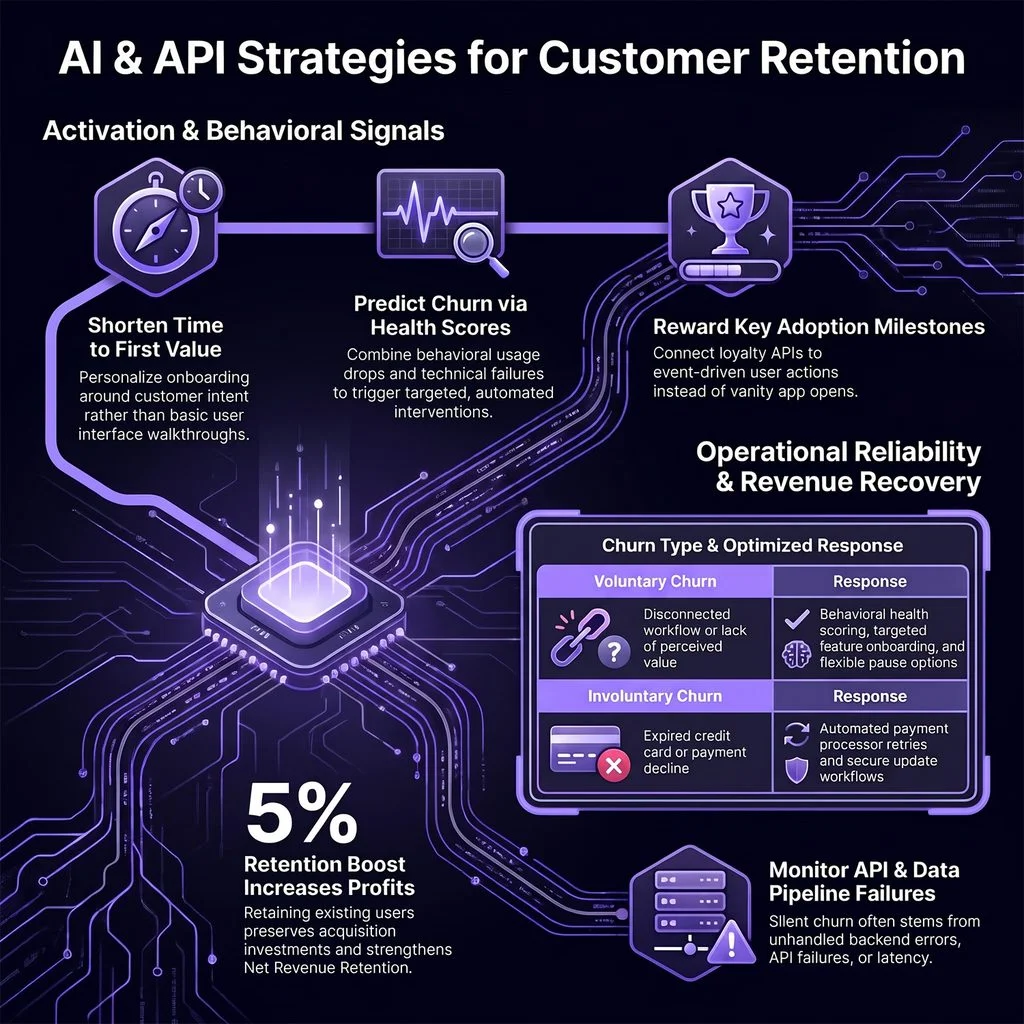
The economics make the effort worthwhile. A Harvard Business Review article, published in 2014, cites research suggesting that a 5% improvement in customer retention can substantially increase profits in some businesses. The exact effect varies by industry and margin structure. The underlying principle remains useful: replacing lost customers is expensive, particularly when acquisition costs are already high.
The following ten approaches show how businesses can build retention into their products and operations instead of waiting until a customer is ready to leave.
Listen this expanded topic: How to Stop Quiet Customer Churn (24 min)
At a glance
- Start with activation. Track whether customers complete a valuable task, not merely whether they log in.
- Use AI for diagnosis, not guesswork. Predictive scores are useful only when they lead to relevant action and can be tested against outcomes.
- Connect the systems that already hold customer signals. Event-driven APIs can link purchases, product usage, rewards, and support history.
- Separate product churn from billing failure. Customers who want to leave and customers whose cards fail need different responses.
- Measure retained value. Repeat usage, renewal rates, and net revenue retention say more than clicks on a re-engagement email.
1. Shorten time to first value with personalized onboarding
Most onboarding flows teach users where buttons are. Successful onboarding helps them accomplish the task that brought them to the product.
For an AI research platform, that might mean completing a first useful analysis and asking a meaningful follow-up question. For an ecommerce loyalty program, it might mean earning and successfully redeeming the first reward. In both cases, the activation event should reflect value delivered rather than a screen viewed.
Build onboarding around intent
Ask what the customer wants to achieve, then adapt the first steps to that answer. An AI assistant can help select a relevant example, draft a starting task, or explain an unfamiliar feature in plain language. Rules-based personalization often works just as well for simple cases; there is no reason to call a language model when a few clear conditions will do.
Track time to first value (TTFV) from registration to the first meaningful outcome. Also measure the percentage of users who complete that outcome and return for another session. A fast first action means little if it does not translate into sustained use.
Keep the first 90 days visible
The first session matters, but retention cannot stop there. Different cohorts need different checkpoints. A seven-day AI software trial may require intervention within hours, while a complex B2B deployment may take several weeks to demonstrate value.
For sales-assisted accounts, record the promised business outcome, the person responsible, and the date by which success should be evident. For self-serve products, use behavioral milestones. If a user completes setup but never applies the product to a real task, a personalized tutorial is more useful than a generic upgrade offer.
2. Build repeat value through loyalty APIs and event-driven rewards
Loyalty programs work best when they acknowledge behavior the customer already considers worthwhile. Points for opening an app are easy to manufacture. Rewards tied to repeat purchases, successful referrals, or meaningful engagement have a clearer relationship to customer value.
Connect rewards to real customer events
Businesses can use a loyalty program api from platforms like Open Loyalty to create reward programs without rebuilding their entire backend. An API-based loyalty engine can apply earning rules, manage points and tiers, and return reward information to the product experience when relevant events arrive.
A retailer might issue points after a completed transaction. A subscription service might recognize a renewal milestone. An AI SaaS business could test benefits for users who establish a consistent workflow, provided the incentive rewards useful adoption rather than unnecessary consumption.
AI adds a possible decision layer. It can help group customers by behavior, recommend an appropriate offer, or identify when a reward is unlikely to change retention. The loyalty API then executes the approved rule. That distinction matters: the AI proposes or selects an action; the underlying system records what actually happened.
Test rewards against a control group
A discount can increase renewals while reducing revenue. Track incremental retention, reward redemption, gross margin, and repeat activity. Compare customers receiving an offer with an appropriate holdout group, not just with people who ignored it.
The goal is repeat value, not a higher count of promotional messages.
3. Make software, APIs, and connected hardware reliable
Retention systems depend on accurate signals. If an app records a successful action but the billing, analytics, or reward service never receives it, the customer may have a poor experience even though every individual dashboard looks healthy.
That problem extends beyond software interfaces. Modern loyalty and customer engagement systems can collect events from retail terminals, kiosks, smart vending machines, EV chargers, and connected products. A failed device event can mean a missing reward, an incorrect customer history, or an automation that never fires.
Treat physical touchpoints as part of the data pipeline
Imagine a loyalty program that awards points for purchases at a smart vending machine. The device must reliably record the transaction, transmit it through an API, and receive confirmation. The loyalty engine then applies the earning rules. A predictive model is not much help if the original purchase event was lost.
This is why embedded engineering matters to digital customer retention. Businesses pursuing custom electronic product development may work with specialists such as Conclusive Engineering to design and build connected hardware that reliably captures and transmits events. The physical device and the software retention system serve different roles, but the quality of their integration affects the customer’s experience.
Monitor failure as a customer experience signal
Track more than uptime. Measure event-delivery success, duplicate transactions, delayed reward issuance, failed API calls, checkout errors, and unresolved device faults. Use idempotent transaction IDs and retry queues so temporary network failures do not create missing or duplicate rewards.
For AI products, reliability also includes response failures, unexpected latency, and workflows that stop before producing an answer. A customer who repeatedly experiences failed tasks may churn without ever submitting a support ticket.
4. Predict churn using behavioral signals and customer health scoring
A churn model should answer a practical question: Which customer needs attention, and what action has a reasonable chance of helping? A risk percentage alone does not retain anyone.
Start with interpretable signals
Combine signals such as days since the last meaningful action, change in usage frequency, incomplete onboarding, repeated task failures, unresolved support requests, and plan utilization. For B2B accounts, a lost internal champion or falling team adoption may matter more than the login count of any individual user.
AI-native products need special care here. A customer who runs twenty prompts on day one and nothing afterward may have been experimenting. Another who runs one demanding task every Friday may be getting exactly the value they paid for. Raw message volume cannot distinguish them.
Begin with transparent rules, then test whether a statistical or machine-learning model improves prediction. Validate it on later cohorts, not only on the data used to train it. Also review false positives: unnecessary intervention can annoy perfectly healthy accounts.
Turn risk into specific actions
A decline after repeated errors should trigger a technical-support route. A customer who has not discovered a core feature might receive a relevant walkthrough. A high-value account approaching renewal without reaching its success criteria may need a human conversation.
Record the reason for the intervention, whether it was delivered, and what happened afterward. Over time, this becomes a way to evaluate retention actions rather than merely to rank customers by risk.
As Gainsight’s guide to churn explains, losing customers is a recurring revenue problem, not just a customer-success metric. Even a 5% monthly churn rate would compound to roughly 46% of the starting customer base lost over a year if there were no replacement customers or reactivations.

5. Automate payment recovery without confusing it with product churn
A failed renewal does not necessarily mean the customer wants to leave. Cards expire, banks decline transactions, and payment details change. Treating every failed charge as dissatisfaction produces inaccurate churn analysis and poor customer communication.
Design a recovery sequence around billing events
A payment processor can notify the application when a charge fails. From there, an automated workflow can schedule retries according to processor guidance, send a secure payment-update link, and stop reminders once the account is recovered.
AI can assist with classifying support replies or tailoring messages for different account types. It should not decide arbitrary retry schedules, bypass payment controls, or expose sensitive card information to a language model.
Report voluntary and involuntary churn separately
Use distinct measures for customers who actively cancel and customers lost after payment failures. Gainsight’s churn resource provides broader context on diagnosing account loss; the operational distinction is essential regardless of the benchmark used.
Measure failed-payment rate, recovery rate, time to recovery, and revenue recovered. Those figures tell you whether billing automation works. A product adoption campaign cannot repair a broken card, and a dunning email cannot solve missing product value.
6. Use AI to turn customer feedback into action
Most companies already have more feedback than they can comfortably read: survey answers, chat transcripts, support tickets, cancellation reasons, reviews, and messages to account managers. The problem is extracting consistent findings and acting on them.
Ask at the moment the experience is fresh
A short customer-effort question after support resolution can be more informative than a long quarterly questionnaire. Ask whether the customer achieved the intended outcome and what got in the way.
Zendesk’s customer experience research and statistics offer a useful starting point for understanding how service interactions shape loyalty. The operational lesson is to inspect difficult interactions rather than relying only on an average satisfaction score.
Classify feedback, then verify the diagnosis
Language models can group free-text responses into themes such as missing features, poor reliability, confusing pricing, or weak support. They can summarize recurring complaints and identify cases that need immediate attention.
But sentiment classification is not the same as understanding causation. Review representative tickets, preserve the original customer language, and check whether the proposed explanation fits the actual product events. A system that automatically labels every frustrated message as “price sensitivity” can hide an expensive reliability problem.
Close the loop with the customer when a problem has been fixed. That final step is often more valuable than collecting another score.
7. Introduce secondary onboarding when customer needs evolve
A customer who completes onboarding is not necessarily familiar with the full product. Features change, teams grow, and new workflows become relevant months after the original signup.
Recommend the next useful capability
Secondary onboarding should respond to demonstrated needs rather than advertise every newly released feature. If a user repeatedly exports raw data, offer the reporting feature that could replace the workaround. If an AI platform user regularly conducts long research sessions, introduce document management or a more structured analysis workflow.
Use event triggers to detect the opportunity. An AI assistant may help explain why the feature matters for that user’s task, but the recommendation should be grounded in observed behavior and accurate feature availability.
Measure adoption beyond clicks
A tooltip click is not feature adoption. Track whether the customer completed a meaningful workflow, returned to it, and continued using the product after the initial prompt.
For complex software, offer concise learning paths, realistic examples, and role-specific tutorials. Compare the retention of appropriately matched cohorts, accounting for the fact that customers who choose training may already be more engaged.
8. Make cancellation and winback workflows responsive to the reason for leaving
A cancellation screen that offers the same discount to everyone cannot address ten different reasons for leaving. A customer whose project ended has a different problem from one who believes the product is unreliable.
Offer an alternative only when it fits
Give customers a clear cancellation path. Where the product supports it, offer a pause for temporary inactivity, a downgrade for budget pressure, or help from support when technical problems remain unresolved. Avoid confusing choices, hidden buttons, and repeated attempts to block cancellation.
Record the stated reason alongside actual usage and support history. AI can help classify open-ended responses, but keep the customer’s original explanation available for review.
Personalize winback around what changed
A former customer who left because an important feature was missing may respond to a message when that feature ships. Someone who left because of repeated downtime needs evidence that reliability improved. Customers who only needed the product for a short project may be better served by a reminder when a similar seasonal need returns.
Track reactivation, subsequent paid retention, and the cost of any incentive. Winning a customer back for one discounted month is not necessarily a commercial success.
9. Connect customer success with expansion revenue
Retention is not limited to preventing cancellations. Existing customers may purchase additional seats, move to higher tiers, or adopt new products when their requirements grow. The useful question is whether expansion follows genuine value, rather than pressure to upgrade.
Use product data to identify expansion readiness
An account approaching a seat limit, repeatedly using advanced workflows, or expanding across departments may benefit from a different plan. These are useful signals for customer success and sales teams.
AI can summarize usage patterns and propose a timely outreach message. People should still review high-value recommendations, especially where pricing or account commitments are involved.
Judge growth through net revenue retention
Net revenue retention (NRR) compares starting recurring revenue with the revenue remaining from that same customer cohort after expansion, contraction, and churn. New-customer revenue does not belong in the calculation.
A simple example: start with $100,000 in monthly recurring revenue, lose $5,000 through churn and downgrades, and gain $8,000 in expansion from the same customers. Ending cohort revenue is $103,000, so NRR is 103%.
Track NRR alongside logo retention and gross revenue retention. Expansion can make NRR look healthy while an unacceptably large number of smaller customers continue to leave.
10. Combine customer education, communities, and AI-assisted support
Customers often abandon tools they never fully learned to use. Accessible help, realistic examples, and strong communities can reduce that friction, particularly for software with complicated workflows.
Help customers solve problems without losing context
An AI support assistant can retrieve relevant documentation, suggest the next step, and pass a concise issue summary to a human when it cannot help. Retrieval should use current product documentation, not guesses from a model’s general training data.
An unresolved issue should remain unresolved in reporting even if the support ticket is closed. Research discussed by Customer Experience Magazine, based on a Capacity study, found that more than 30% of surveyed customers reported leaving a brand after one unresolved or partially resolved support interaction. The distinction between ticket closure and customer resolution matters.
Build useful peer knowledge
Communities work when members exchange workflows, templates, troubleshooting advice, and hard-earned lessons. A discussion board with no meaningful participation adds little value.
AI can make existing community knowledge easier to search and summarize. Human moderation and clear source links are still needed, especially when advice depends on a product version or a security-sensitive setting.
Measure repeat participation, successful self-service resolution, and adoption of documented workflows. Community membership by itself does not prove that retention has improved.

How to put the strategies into practice
Launching ten retention projects at once creates a new coordination problem. Start with the part of the customer journey where the greatest avoidable loss occurs.
- Establish the baseline. Segment customers by acquisition source, plan, tenure, and use case. Measure activation, retention, revenue churn, and failed payments separately.
- Find the earliest preventable drop-off. Look for a significant fall between signup and first value, first value and repeat use, or active use and renewal.
- Connect one signal to one intervention. For example, a successful signup without a meaningful first task could trigger a personalized starting workflow. Repeated API failures should trigger an engineering investigation, not a promotional email.
- Test the outcome. Use holdout groups where practical. Measure renewal or retained revenue, not just email opens, rewards issued, or clicks.
The best retention system is not the one with the most automation. It is the one that correctly recognizes why a customer is losing value, responds appropriately, and can demonstrate that the response helped.
FAQ
What is customer churn and how is it calculated?
Customer churn rate is the number of customers lost during a period divided by the number of customers at the start of that period, multiplied by 100. Revenue churn measures lost recurring revenue instead of lost accounts. The two can tell different stories. CRV’s SaaS churn benchmarks illustrate why company stage, customer segment, and the choice between logo and revenue churn matter when comparing performance.
Why invest in retention instead of focusing only on acquisition?
Retention preserves the revenue generated by earlier acquisition spending. An often-cited Harvard Business Review analysis notes that acquiring customers can cost several times more than keeping existing ones, although the ratio varies widely. Businesses need both acquisition and retention; improving one does not automatically fix the other.
What is the difference between voluntary and involuntary churn?
Voluntary churn occurs when customers choose to cancel. Involuntary churn generally results from unsuccessful subscription payments or related administrative failures. The two require different remedies. For broader definitions and implications, see Gainsight’s guide to churn.
Why do customers stop using AI-powered software?
Some never reach their first useful outcome. Others find that their need was temporary, encounter unreliable responses, struggle with workflow complexity, or cannot justify recurring spending. A high number of prompts during a trial does not necessarily mean the customer has formed a lasting habit. Assess return usage, successful task completion, and renewal behavior together.
How can AI and customer health scores reduce churn?
Predictive systems combine behavioral and account signals to identify customers who may need attention. AI can help interpret feedback, recommend relevant assistance, and route cases to the right team. It cannot guarantee retention. Test predictions against actual cancellations and evaluate whether interventions improve outcomes compared with a suitable control group.