
The fastest way to torpedo a pitch is an elegant business plan built on unverified assumptions. Many founders search for the best AI for creating business plans to save time. They often end up with a neat narrative that glosses over where the numbers originate.
Investors now ask for sources and a rationale they can audit. They want to see sensitivity analysis and defensible market sizing. Most prompt-based generators fail this test completely.
Founders face immense pressure during seed and series funding rounds. They need defensible market sizing without spending weeks on manual research. They also have a low tolerance for bad data in their financial models.
- Manual research delays: Teams spend weeks finding reliable industry benchmarks.
- Fragmented workflows: Users jump between text editors and complex spreadsheets constantly.
- Poor agreement: Partners disagree on basic assumptions and financial drivers.
- Formatting struggles: Creating documents that meet exact lender requirements takes hours.
What Makes a Business Plan Credible Today
A modern business plan must survive intense scrutiny from investors and partners. You need a solid foundation of sourced market data and explicit assumptions. The financials must reconcile perfectly across your profit and loss statement.
Cash flow and balance sheets must match your written narrative exactly. You must prove your unit economics work at scale. A software company must validate its ideal customer profile clearly.
They must prove a realistic payback period based on usage pricing. A direct-to-consumer brand must model cost of goods sold accurately. They need to show a clear contribution margin and channel mix.
The Cost of Bad Data
Presenting unverified numbers damages your reputation permanently. Venture capitalists share information about founders who present flawed models. A single hallucinated statistic can derail an entire funding conversation.
You lose the benefit of the doubt immediately. Rebuilding trust takes months you do not have. Your baseline assumptions must withstand aggressive questioning from industry veterans.
Common AI Failure Modes
Basic AI tools often assemble a convincing but deeply flawed document. These systems regularly produce hallucinated statistics and inconsistent financial projections. You might find a copy-paste SWOT analysis that lacks real substance.
These errors destroy credibility during a critical funding round. You cannot afford to present unverified data to a board of directors.
- Fabricated market sizes: AI invents total addressable market numbers entirely.
- Disconnected financials: Revenue growth outpaces customer acquisition costs without logic.
- Generic strategies: The plan lacks exact go-to-market mechanics and details.
- Missing citations: You cannot trace benchmarks back to primary industry sources.
Why Single Models Drift
Relying on a single AI model introduces significant risk to your planning. These models suffer from knowledge cutoffs and inherent training biases. They lack the ability to present missing counter-arguments automatically.
A single perspective often validates your flawed assumptions without pushback. You need a system that challenges your thinking instead of agreeing constantly.
Evaluating AI Business Plan Generators
You must evaluate tools based on research provenance and financial modeling depth. Collaboration features and auditability matter just as much as final export quality. The right tool acts as a strategic partner rather than a typing assistant.
Core Selection Criteria
Do not settle for a tool that just fills in blank templates. You need a platform that handles complex scenario analysis easily. The system must ground all responses in your own uploaded documents.
- Research provenance: The tool must cite verifiable sources for every statistic.
- Financial depth: It should model unit economics and detailed cash runway.
- Audit trail: You need a complete history of changed business assumptions.
- Export quality: The output must fit exact formats for different audiences.
Integrating Your Existing Knowledge Base
The best tools read your existing company documents accurately. They ground their responses in your actual historical performance. You can upload past performance reviews and customer interviews.
The AI extracts recurring themes and actual conversion rates. This creates a plan based on reality rather than generic industry averages.
Tool Categories Compared
The market offers several distinct categories of planning software. Prompt-based generators work well for a quick lean canvas but fail at complex math. They treat a five-year projection as a creative writing exercise.
This leads to impossible growth curves and ignored expense lines. Template-first apps organize your thoughts but require heavy manual research. Financial-first tools build great spreadsheets but struggle with narrative flow.
Multi-model orchestration platforms combine the strengths of these different systems. They provide both mathematical rigor and compelling narrative structure.
The Multi-Model Advantage
Using multiple AI models simultaneously provides a massive competitive advantage. You can run AI hallucination mitigation protocols to cross-check facts. One model generates the initial strategy while another verifies the underlying logic.
This approach builds consensus and reduces risk in your strategic planning. You can explore a complete strategy planning use case to see this in action.
A Practical Workflow for AI Business Planning
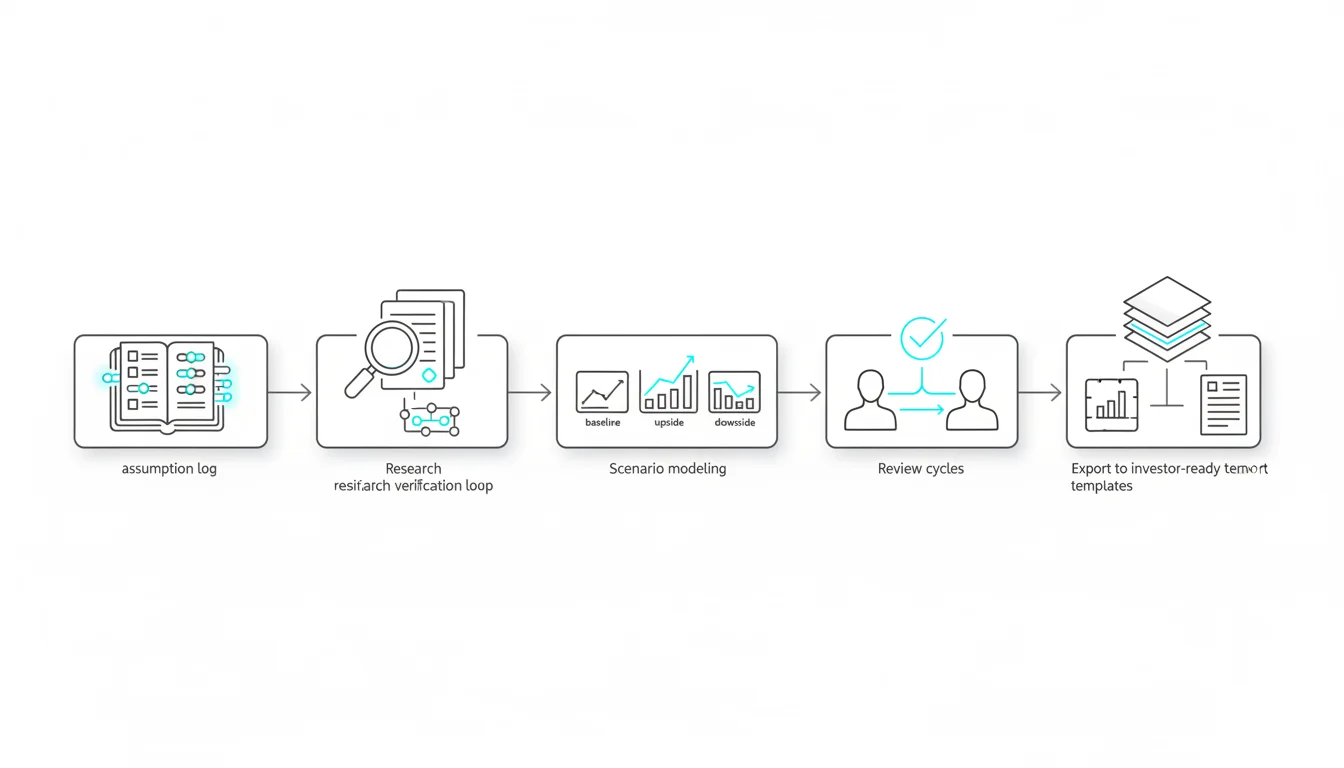
You need a procedural playbook to turn raw outputs into reliable documents. This workflow builds verification checkpoints into every step of the process. Your plan becomes a living model rather than a static file.
Building an Assumption Log
Start by documenting every key driver of your particular business. This explicit assumption ledger wires your financial projections to reality. You must track these variables meticulously throughout the planning process.
- Market size: Define your TAM SAM SOM clearly and realistically.
- Pricing strategy: Document your exact revenue model and pricing tiers.
- Customer churn: Estimate realistic attrition rates based on industry averages.
- Acquisition costs: Calculate your blended cost to acquire a single customer.
- Payback period: Know exactly when a new customer becomes profitable.
The Research Verification Loop
Never accept an AI-generated statistic at face value. Dedicated competitor research AI tools scan the market for emerging threats. You must find the data and cite the primary source directly.
Watch this video about best ai for creating business plans:
Adjudicate any conflicting information through careful review and cross-checking.
- Find the data: Locate the raw statistics from trusted industry reports.
- Cite the source: Document the exact origin for future reference.
- Adjudicate conflicts: Resolve differing data points using multiple AI models.
- Update the model: Adjust your financial projections based on verified facts.
Modeling Financial Scenarios
A credible plan requires multiple financial scenarios to show preparedness. Start with a realistic baseline case based on current market data. Build out your aggressive upside and conservative downside projections next.
Test your sensitivity to three to five key business levers. Investors want to see how changes in pricing affect your cash runway.
Review Cycles and Approvals
Your planning process requires multiple rounds of human review. Send the draft to your technical leads for a reality check. Ask your sales director to verify the revenue assumptions.
Capture all their feedback in a centralized document history. This prevents version control nightmares during the final days before a pitch.
Assembling the Narrative
Write your executive summary last to capture the complete picture. Use a reliable go-to-market plan template to structure your thoughts. Build your operating plan and detailed marketing strategy first.
Make sure every figure in the text reconciles with your financial tables. You can export to investor-ready business plan templates to format the final output. Match the document format precisely to your exact target audience.
Platform-Specific Workflows That Reduce Risk
Advanced platforms offer specialized modes for high-stakes business decisions. These features prevent the confirmation bias that ruins many startup pitches. You can build a specialized AI team for domain-specific workflows.
Stress-Testing with Debate Mode
A multi-model debate forces opposing views into the open immediately. You can assign one model to act as a skeptical venture capitalist. Assign another model to defend the founder’s original vision aggressively.
This interaction surfaces blind spots you would never see alone. It helps you prepare your pitch deck before the actual meeting. See how Debate Mode structures critical challenges.
Challenging Assumptions with Red Team
Your financial projections are likely fragile in certain untested areas. A Red Team mode targets these hidden weaknesses aggressively. It tests your revenue and cost drivers against extreme edge cases. Use Red Team Mode to pressure-test assumptions.
This adversarial check exposes hidden flaws in your unit economics. You can fix these issues before a lender spots them.
Building Consensus on Data
You can use an AI Boardroom for multi-model consensus on assumptions and benchmarks. The system scans multiple pipelines and extracts relevant data systematically. It synthesizes the findings and provides exact citations for every claim.
An adjudicator fact-checking layer verifies the source material thoroughly. A persistent context fabric keeps all models aligned on your business details.
Frequently Asked Questions
Which tool is best for creating business plans?
The ideal platform uses multi-model orchestration to verify all data. Single-model tools often invent numbers and fail at complex financial modeling. Look for software that includes adversarial testing and clear audit trails.
How do these solutions handle financial projections?
Basic generators output generic three-statement models without citing industry benchmarks. Advanced platforms link your exact assumptions to unit economics and cash runway. They allow you to run multiple sensitivity scenarios easily and accurately.
Can an AI business plan maker write an executive summary?
Yes, but you should generate the summary after completing the full plan. The system needs the complete context of your ongoing business and financials. This guarantees the narrative perfectly matches your data tables and projections.
Moving from Draft to Investor-Ready
You must prioritize research integrity over flashy prose and generic statements. A repeatable verification loop turns your draft into a defensible asset. Your final document must withstand intense financial scrutiny from external parties.
- Verify all data: Counter bias and surface blind spots early.
- Document everything: Keep an explicit ledger for all financial drivers.
- Test boundaries: Run your model against upside and downside cases.
- Format correctly: Export documents tailored for lenders or investors.
A verified plan becomes a living model for your ongoing business. Build your strategy with multi-model consensus and export it today. You will enter your next funding round with complete confidence.