


Interactive lesson · Suprmind Data Lab
AI Hallucinations, Benchmarks, and Multi‑Model Defense
Why AI models make things up, why hallucination leaderboards contradict each other, and how cross-checking several models catches fabrications before they cost you. With a slide deck, flashcards, a mind map and a quiz.
Introduction
Did you know that when an AI model gives you a completely wrong answer, it doesn't hesitate or show doubt—in fact, studies show models often become more confident in their answer after making a mistake? Across six major AI labs, new models released from July to September 2026 had a median hallucination rate of 55.2%: when they don't know an answer, they give a wrong one more often than they admit it.
In this interactive lesson, you will dive into the mechanics of AI hallucinations, decode why benchmark leaderboards seem to contradict one another, and explore the mathematical realities and multi-model strategies used to catch AI fabrications before they cost real-world time and money.
What you will learn
- Define intrinsic and extrinsic AI hallucinations and explain the psychological confidence paradox in large language models.
- Analyze why different AI benchmarks (such as Vectara, AA-Omniscience, and FACTS) produce wildly contradictory hallucination scores for the exact same model.
- Evaluate the reasoning tax and quantify the impact of web search access on factual accuracy across law, healthcare, and finance.
- Formulate a multi-model validation strategy leveraging cross-model orchestration and independent verification layers to mitigate hallucination risks.
The Hallucination Phenomenon & Confidence Paradox
Imagine asking an expert a tricky question. If they don't know the answer, a human will usually pause, hedge, or admit ignorance. An AI language model, however, functions as a high-speed statistical probability engine. It does not query a database of verified truths; it predicts the most statistically likely next token based on patterns in its training data. When it hits a gap in its knowledge, it fills that gap with fluent, persuasive prose rather than staying silent.
In AI research, this fabricative behavior is divided into two primary categories:
- Intrinsic Hallucinations (Faithfulness Failures): The AI directly contradicts information provided in its input prompt or reference document. For instance, if you upload a data processing agreement stating a 72-hour breach notice window and the AI summarizes it as a 24-hour rule, it has suffered an intrinsic hallucination.
- Extrinsic Hallucinations (Factuality Failures): The AI generates information that cannot be verified against any known source material. It invents nonexistent court cases, fake journal DOIs, or fabricated financial statistics from scratch.
What makes hallucinations particularly dangerous is The Confidence Paradox. In a 2025 study published in Memory & Cognition by Cash and Oppenheimer, humans and AI models were asked to complete identification tasks and rate their self-confidence before and after answering. While humans revised their self-assessments downward after struggling with hard questions, AI models actually revised their confidence upward—estimating in retrospect that they scored dramatically higher than their actual accuracy!
Furthermore, researchers have published formal mathematical proofs showing that zero hallucination is impossible for general-purpose language models. Research by Karpowicz demonstrated that no inference mechanism can simultaneously achieve truthful response generation, semantic information conservation, relevant knowledge revelation, and knowledge-constrained optimality. Because language models predict plausible text rather than compute absolute truth, hallucination is a structural property of the architecture that can only be managed, never completely eliminated.
Intrinsic hallucination
Faithfulness failure
The model contradicts the source it was given, such as a contract summary that adds a clause the contract doesn't contain.
Extrinsic hallucination
Factuality failure
The model invents facts, statistics or citations that no source supports, such as a quote from the "Journal of Nonexistent Studies (2024)".
The confidence paradox
Cash and Oppenheimer, Memory & Cognition (July 2025)
Humans lowered their self-assessment after struggling. The models raised theirs.
Identical tone across errors
FactualThe speed of light is approximately 299,792,458 meters per second.
FabricatedThe average global temperature in 2023 was 35°C.
A language model sounds equally sure of both.
The Benchmark Battlefield – Why AI Scores Contradict Each Other
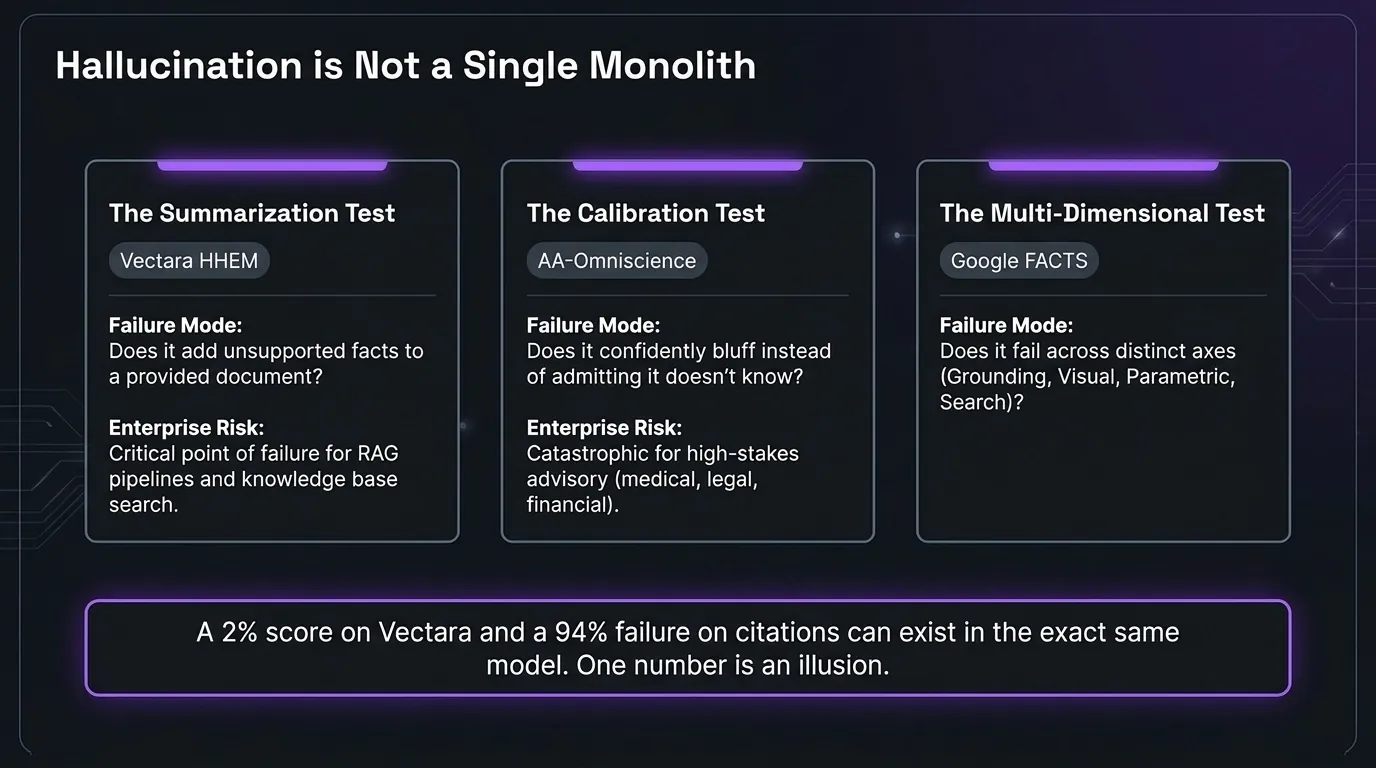
If you ask five AI engineers which model hallucinates the least, you might receive five different answers. Why? Because different benchmarks measure completely different failure modes.
Consider xAI's Grok-3: on the Vectara HHEM benchmark—which measures how faithfully a model summarizes a document without adding unsupported facts—Grok-3 scores an impressive 2.1% hallucination rate. Yet on the Columbia Journalism Review (CJR) citation accuracy test, that exact same model hallucinates citations 94% of the time!
This isn't an error. It highlights the critical difference between specific benchmark methodologies:
- Summarization Faithfulness (e.g., Vectara): Measures whether a model sticks strictly to source documents. Models like finix_s1_32b (1.8% on Vectara's 7,700-article dataset) and GPT-5.4 nano (3.1%) lead here.
- Knowledge Calibration (e.g., AA-Omniscience): Measures whether a model admits ignorance when it doesn't know an answer, rather than guessing. Here, Gemini 4 Carbon (medium) posts a benchmark-leading 4.2% hallucination rate (at 48.9% accuracy), while Gemini 4 Argon leads public models at 4.3% (at 48.3% accuracy). Meanwhile, highly knowledgeable models like Claude Fable 5.1 achieve a top accuracy of 68.4% but fabricate answers 70.0% of the time when unsure!
- Multi-Dimensional Factuality (e.g., FACTS): Evaluates models across four distinct slices: Grounding, Multimodal, Parametric Knowledge, and Search. GPT-6 Astra leads fully scored models on the Kaggle FACTS board with a score of 78.1, powered by a 93.3 score on search-grounded queries.
Understanding these distinctions is vital. A model advertised as having a 'low hallucination rate' might excel at summarizing enterprise PDFs while being wildly overconfident and inaccurate on ungrounded strategy questions.
The Reasoning Paradox & High-Stakes Sector Risks
As AI frontier labs introduced reasoning models (such as GPT-6 Astra, Claude with extended thinking, or DeepSeek-R1), researchers discovered a counterintuitive phenomenon: The Reasoning Paradox.
Reasoning models use chain-of-thought processing to excel at complex logic, mathematics, and coding. However, during document summarization, that internal 'thinking' causes models to draw inferences, synthesize unstated connections, and add extra insights. On a summarization test requiring strict adherence to source material, every extra insight gets scored as a hallucination! For instance, DeepSeek-R1 (reasoning) hallucinates at 11.3% on Vectara's new dataset, compared to its base model DeepSeek-V3 at 6.1%.
Fortunately, one feature has a large measured effect: Web Search Access. In OpenAI's own FActScore tests on three of its models, turning on browsing cut hallucination rates by 73% to 86% (o4-mini fell from 37.7% to 5.1%).
When ungrounded AI models are deployed in professional fields, the financial and legal consequences can be swift:
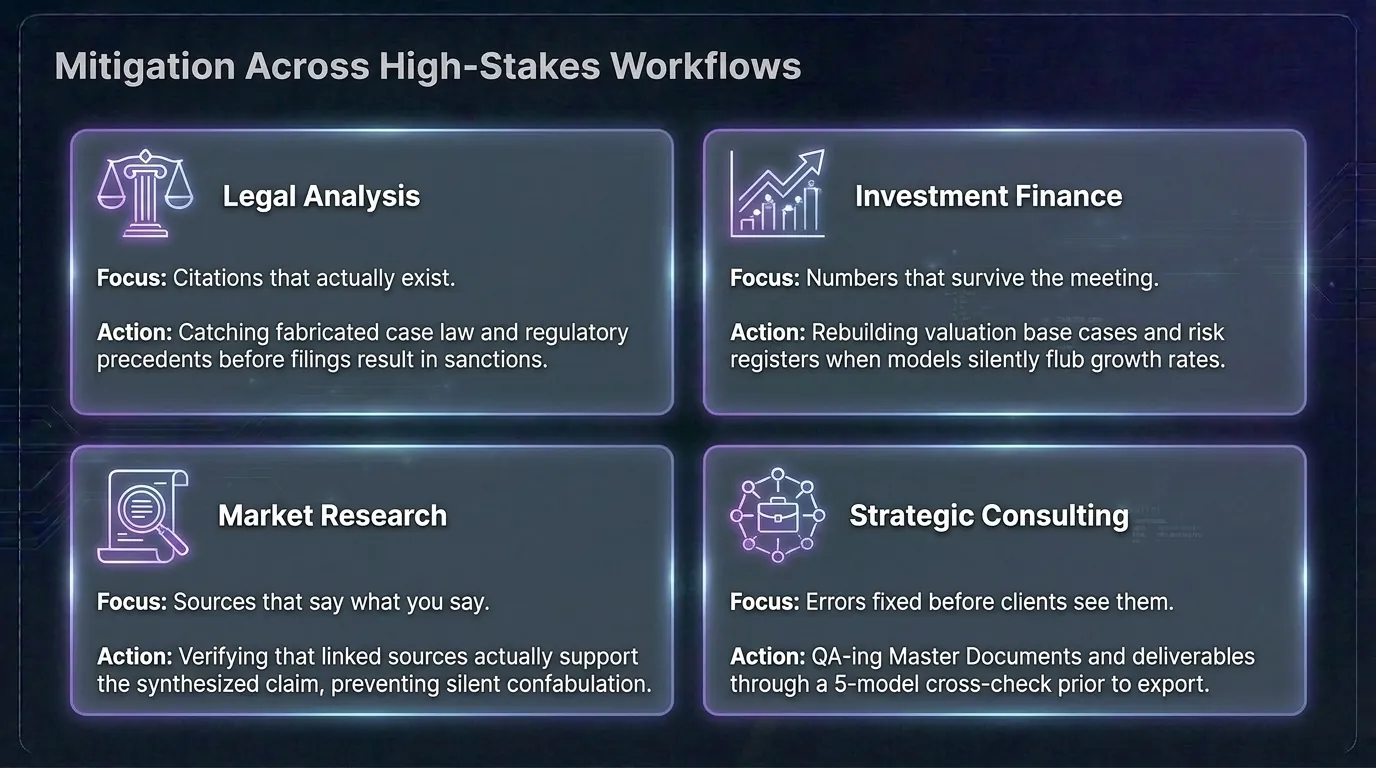
- Legal Analysis: Purpose-built legal AI tools marketed as hallucination-free still err on 17% to 33% of queries (Stanford RegLab study), while general-purpose models fail on specific court case holdings 58% to 88% of the time. Damien Charlotin's database lists 2,266 court decisions worldwide involving AI-hallucinated material (as of November 5, 2026). The largest U.S. amount ordered in a single case is $110,204.
- Healthcare: In clinical tests with planted fake patient details, models built on the fake information in 50% to 82% of cases, though domain-specific mitigation prompts reduced errors significantly.
- Finance: In Suprmind's Divergence Index, financial queries generated twice as many contradictions between models (40%) as medical queries (20%), demonstrating that financial modeling assumptions are extremely volatile across AI providers.
Fighting Hallucinations – Multi-Model Orchestration & The Two-Layer Shield
If no single AI model can ever be 100% hallucination-free, how can professionals produce work they can defend? The answer lies in Multi-Model Orchestration.
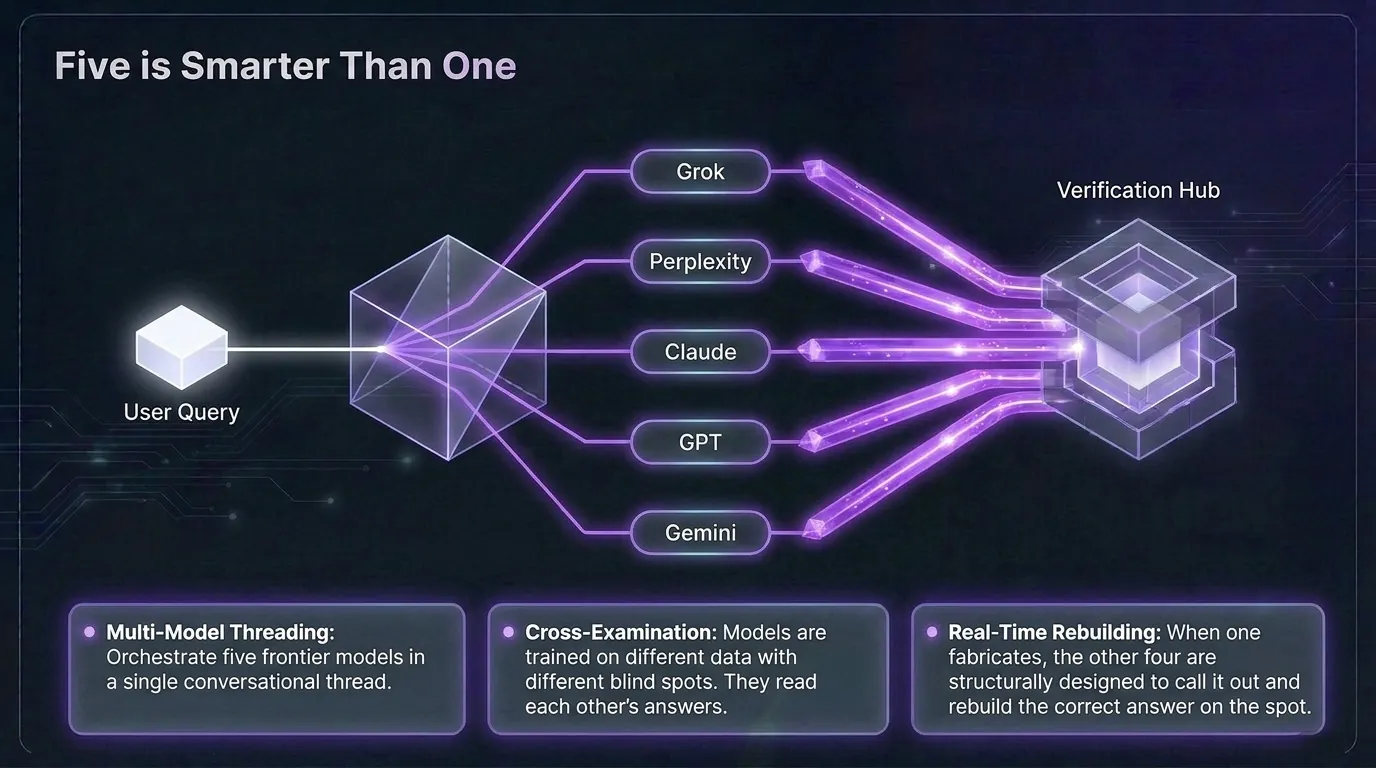
Amazon's Uncertainty-Aware Fusion (UAF) research demonstrated an 8% boost in factual accuracy by combining outputs from multiple LLMs weighted by accuracy and self-assessment quality. This relies on the 'wisdom of the silicon crowd': because models are trained on different data by different companies, their hallucinations are stochastic and uncorrelated. While one model might invent a statistic, four other models reading that answer in the same conversation will immediately call it out.
Suprmind's Data Lab re-checked 17,885 real questions asked on Suprmind between July 30 and September 10, 2026, and found strong production evidence:
- 45% of high-stakes questions drew a direct correction from another model in the conversation (compared to 28% for low-stakes queries).
- Real agreement is rare: In only 0.2% of questions (32 out of 13,563) did models simply agree without adding, contradicting, or correcting anything.
- Fact-check accuracy: When independent judges checked model disputes, the correcting model was right 18 out of 23 times.
To operationalize this defense, modern platforms deploy a Two-Layer AI Anti-Hallucinogen Shield:
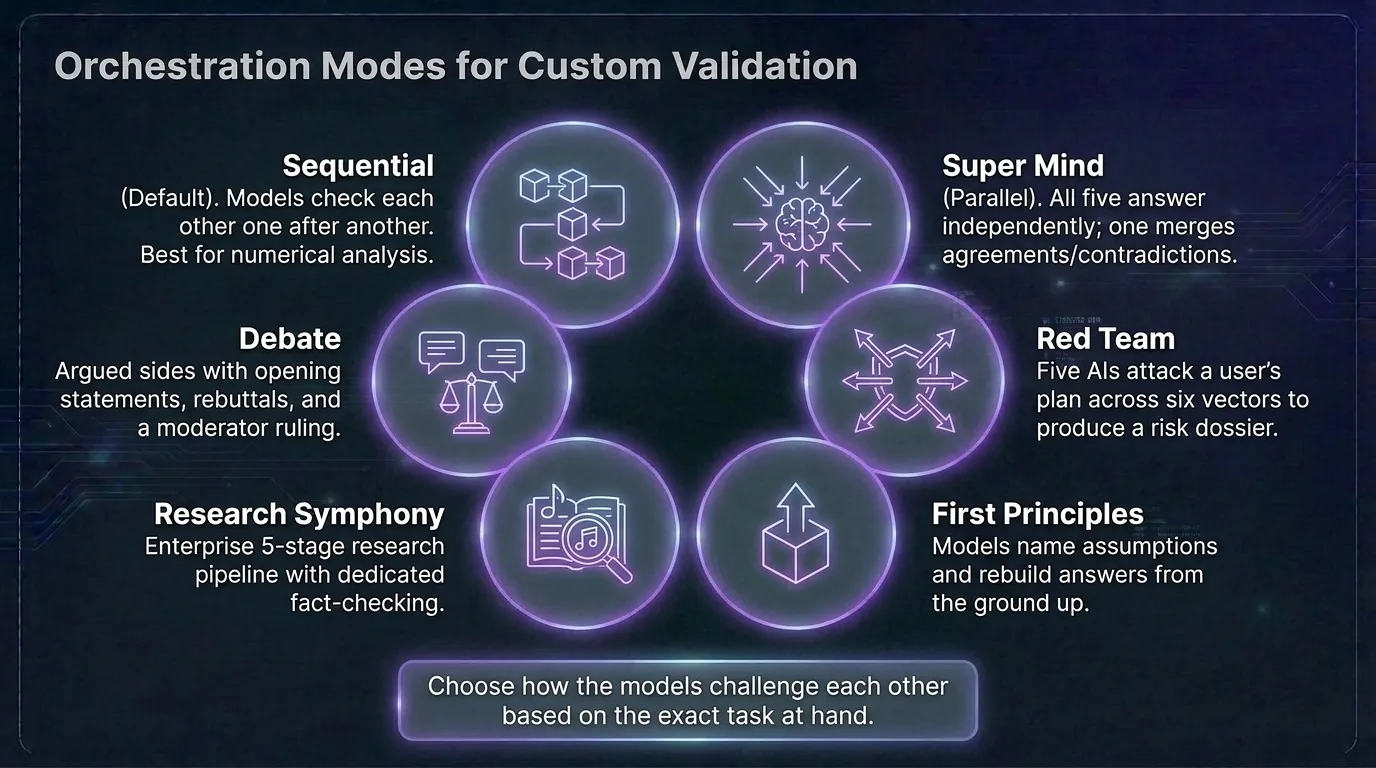
- Layer One (The Boardroom Cross-Check): Five frontier AIs (e.g., GPT, Claude, Gemini, Grok, Perplexity) participate in a single conversation. They read each other's responses live, allowing subsequent models to catch fabrications, correct errors, and rebuild answers before the user acts.
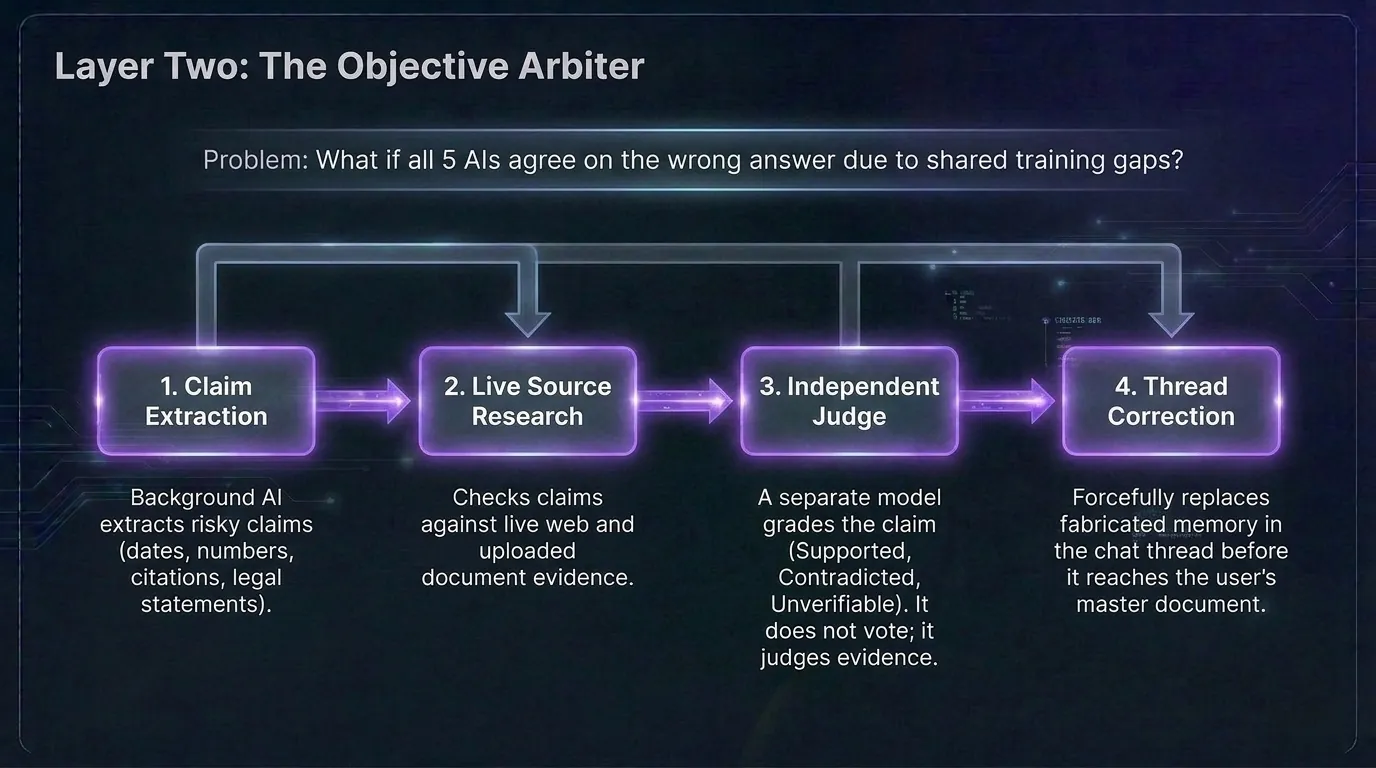
- Layer Two (Independent Fact Checker - True North): An independent AI layer operates outside the conversation. It extracts high-risk claims (numbers, dates, citations, legal holdings), researches them against live web sources and uploaded project files, and uses a separate judge to rule each claim supported, contradicted, or unverifiable—automatically correcting project notes and Master Documents.
Summary
AI hallucinations are not temporary bugs but inherent mathematical realities of next-token prediction language models. While no single model is flawless, combining web-search grounding, selecting task-appropriate reasoning settings, and employing a two-layer multi-model verification shield allows professionals to catch fabrications before they impact critical legal, financial, and strategic decisions.
- Hallucinations are Structural: Models predict statistical plausibility, not ground truth. Impossibility proofs confirm zero hallucination cannot be achieved in general-purpose LLMs.
- Beware the Confidence Paradox: AI models express equal certainty whether they are completely correct or inventing fake citations and case law.
- Benchmarks Test Different Skills: Summarization benchmarks (Vectara) measure document grounding, while knowledge benchmarks (AA-Omniscience) test self-awareness and refusal calibration.
- Web Search Helps, Measurably: In OpenAI's tests on three of its models, browsing cut hallucination rates by 73% to 86%.
- Multi-AI Verification Works: Querying five frontier models in a shared conversation catches fabrications—45% of high-stakes questions draw immediate cross-model corrections.
Catch hallucinations before they reach your work
Suprmind puts five frontier AIs in one conversation, so a fabrication from one gets challenged by the others, and True North checks the claims that matter. Start with Spark: four AIs, 7 days free, no credit card required.
Start your free trialSources for this lesson
- AI Hallucination Rates & Benchmarks 2026: every benchmark figure in this lesson, with methodology and citations.
- Suprmind AI Anti-Hallucinogen: the two-layer verification system and the Data Lab results.
This lesson was drafted with an AI notebook from the two pages above, then checked against them figure by figure.