Feb. 15, 2026
•
Radomir Basta
•
3 min read
KI-Halluzinationsstatistiken: Forschungsbericht 2026
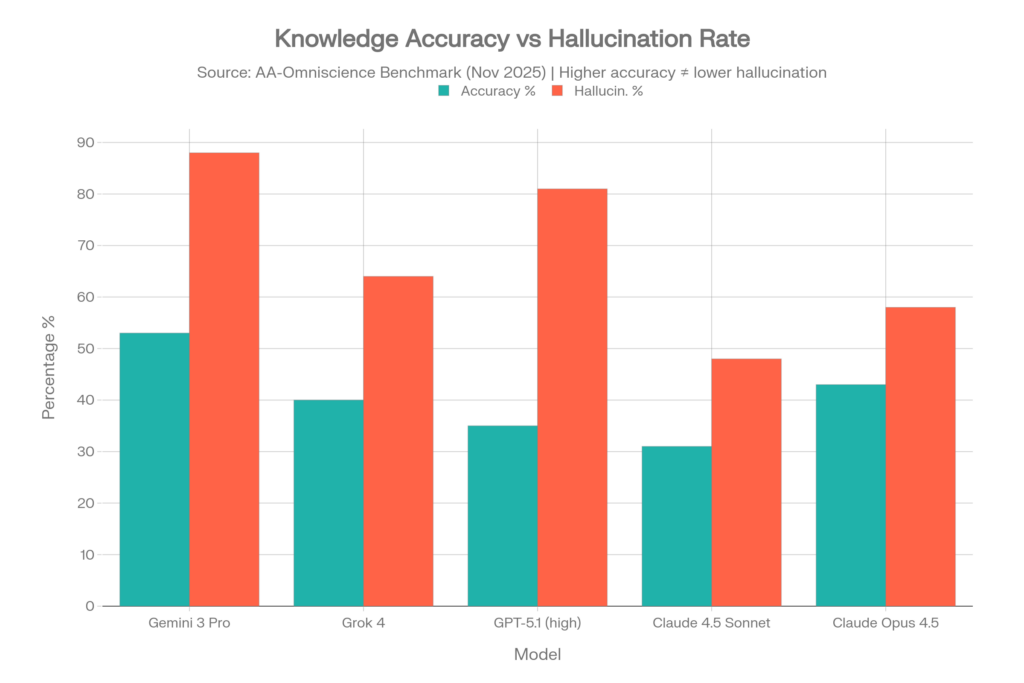
KI-Halluzinationen – Fälle, in denen Modelle falsche oder erfundene Informationen mit voller Überzeugung generieren – stellen eines der kritischsten und...
Read Article →
Sep. 9, 2026
•
Radomir Basta
•
5 min read
Top Decision Intelligence Tools: A Reliability-First Evaluation Guide
You cannot trust a single model's output on a high-stakes decision. Most lists of the top decision intelligence tools skip...
Read Article →
Sep. 7, 2026
•
Radomir Basta
•
9 min read
Thought Leadership: A Decision-Intelligence Approach
Executives do not buy ideas. They buy confidence that your market view reduces risk and creates upside. Most thought leadership...
Read Article →
Sep. 5, 2026
•
Radomir Basta
•
8 min read
Run Multiple AI at Once for Defensible Analysis
Professionals need a tactical way to run multiple AI at once for complex research. You can now operate GPT, Claude,...
Read Article →
Sep. 3, 2026
•
Radomir Basta
•
7 min read
Responsible AI: Traceable, Testable, and Defensible Decisions
If your AI cannot show its work, your risk team cannot sign off. Responsible AI is about making decisions traceable,...
Read Article →
Sep. 1, 2026
•
Radomir Basta
•
6 min read
Prompt Engineering: From Clever Outputs to Decision-Grade Results
Your AI model can write, but can it defend its answer? Prompt engineering is how you move from basic text...
Read Article →
Aug. 28, 2026
•
Radomir Basta
•
12 min read
Productivity Tools for High-Stakes Decisions
If your team ships drafts faster but leaves executives unsure what to trust, you have a major problem. You do...
Read Article →
Aug. 26, 2026
•
Radomir Basta
•
6 min read
Orchestrating Parallel AI for High-Stakes Decisions
You can get a fast answer from one model. You get a dependable answer by orchestrating several in parallel. High-stakes...
Read Article →
Aug. 22, 2026
•
Radomir Basta
•
6 min read
Multiple AI Platform
Your single-model AI agrees with itself. Your stakeholders do not. You need disagreement you can measure. You need a synthesis...
Read Article →
Aug. 20, 2026
•
Radomir Basta
•
9 min read
Multi-Model Consensus AI Platforms for Enterprise
Enterprise AI decisions fail when a single model produces a confident but incorrect answer. The solution requires structured disagreement and...
Read Article →
Aug. 18, 2026
•
Radomir Basta
•
6 min read
Multi-AI Workspace for High-Stakes Decisions
Managers and practitioners often ask how to make multiple models work together. Single-model chats are fast but fragile. One blind...
Read Article →
Aug. 16, 2026
•
Radomir Basta
•
7 min read
Multi AI Platform Contract Clause Analysis
Clause-level mistakes do not fail in aggregate. They fail in one indemnity sentence. They fail in one survivability list. They...
Read Article →
Aug. 14, 2026
•
Radomir Basta
•
6 min read
Evaluating a Medical Literature Review Tool
Your screening backlog grows daily. Inter-rater agreement slips during complex reviews. Reviewers debate citations without a clean audit trail. Systematic...
Read Article →