


ChatGPT Pricing
and Subscription Plans
in July 2026: Go, Plus, Pro,
Business, Enterprise and
API Costs
ChatGPT runs from $0 to $200 per month across five individual tiers: Free at $0, Go at $8, Plus at $20, and two Pro plans at $100 and $200. Teams pay $20 per seat for ChatGPT Business on annual billing, Enterprise is custom, and the flagship GPT-5.6 Sol API bills $5 per million input tokens and $30 per million output.
The tier names are public and so are the prices. The variable that moves the value math more than any other – which GPT model actually answers when you press send – is the one OpenAI does not show you by default.
This guide covers every active subscription price as of July 2026, which model each tier routes to, and where a paid plan quietly buys you less than the headline.
Verified July 22, 2026.
Current ChatGPT pricing for Go, Plus, Pro and Business plans in July 2026
ChatGPT costs from $0 to $200 per month for individuals, plus per-seat business plans. Free is $0 with ads. Go is $8/month, Plus is $20/month, and the two Pro tiers are $100 and $200/month. ChatGPT Business is $20 per seat on annual billing ($25 monthly), and Enterprise is custom. The flagship API model, GPT-5.6 Sol, is $5 per million input tokens and $30 per million output.
Full breakdown of each tier, the model-routing gap, and the complete API rate table below.
ChatGPT 7-day free trial, no card required
Enough about the price. Let’s test ChatGPT for free.
Right here, right now.
Let’s take ChatGPT for a test run. No credit card. Just name, email, password, 20 seconds,
and you are in the Suprmind app, testing ChatGPT and other three AIs (Grok, Claude & Gemini),
in the same conversation.
7 days free. No credit card.
Which model are you
actually using?
This is the question every ChatGPT subscriber has asked at least once, and every comparison article skips. Since the July 9 GPT-5.6 rollout, paid tiers pick between Sol, Terra, and Luna and set an effort level, but in Auto mode the underlying variant is still selected automatically. To see which model handled a query, you have to open a Configure setting most people never touch. API users always get the specific model ID in response metadata. ChatGPT users on default settings do not.
Why this matters for what you pay: a Plus subscriber pays a $20 a month subscription expecting GPT-5.6 Sol, because that is the headline model. The Auto selector may route a query to Sol, Terra, Luna, or an older GPT-5.5 variant based on logic OpenAI has not fully documented. On a hard prompt, you get the flagship. On a routine one, you may not. The price is fixed.
The value per query is not.
Which Model Do You Actually Get?
July 2026 – subject to change without notice
- ~10 messages per 5-hour window, then a smaller fallback
- 16K context (non-reasoning)
- 3 file uploads per day
- Ads in the US (since 2026-02-09)
- Codex Mobile (free preview)
- GPT-5.6 Terra, no Sol access
- 10x Free message and upload limits
- Ads, despite payment
- Expanded memory, Codex Mobile
- Sol, Terra and Luna with effort levels
- GPT-5.4 Pro in Flexible mode
- 10 Deep Research per month, Sora, Agent Mode
- No ads
- 5x Plus message limits
- 5x Plus Codex usage (launch 10x promo ended 2026-05-31)
- Personal Finance preview (US)
- Launched 2026-04-09
- 20x Plus message limits
- 1M-token context for long docs
- Unlimited Sora, highest peak-demand priority
- Personal Finance preview (US)
- $20/seat annual, $25/seat monthly, 2-seat minimum
- SAML SSO, SOC 2 Type 2, ISO 27001/17/18/27701
- No model training on your data
- Codex agent, Deep Research
Source: openai.com/chatgpt/pricing and chatgpt.com – last verified 2026-07-22. Tier-to-model mapping changes monthly. Free and Go get Terra only, so the flagship GPT-5.6 Sol starts at Plus.
The line that matters most in this matrix: GPT-5.6 Sol has been the consumer flagship since July 9, 2026, but Free and Go never reach it. They get Terra, the mid-tier model. A visitor comparing “ChatGPT” against a rival is likely testing a different model than the one the marketing sells. If the model version matters to your decision, the API is the only surface that names it on every call.
See also: AI catch ratio data →
The ChatGPT free version:
$0, and no longer pure free.
Since February 9, 2026, the US Free tier shows advertisements – the first time OpenAI has placed ads in ChatGPT. The tier runs GPT-5.6 Terra, capped at roughly 10 messages per 5-hour window before it falls back to a smaller variant. The non-reasoning context window is 16K tokens, a fraction of Plus, which is the single clearest reason to upgrade for document work.
The real cost of Free shows up the moment you act on an answer. Per the Suprmind Multi-Model Divergence Index (April 2026 Edition, n=1,324 production turns), ChatGPT’s catch ratio is 0.38 – it gets caught by other models 295 times for every 111 corrections it makes. On Free without web search enabled, the citation hallucination rate reached 67% in the Columbia Journalism Review audit cited in Suprmind’s AI Hallucination Rates and Benchmarks reference. Free is fine for casual queries. It is not fine for citation-dependent work, even at a price of zero.
See how OpenAI GPT works with four other frontier models in a multi-AI orchestrated business discussion
Click Start (not a video) to see how Suprmind orchestrates OpenAI’s GPT and four other frontier AIs in the same conversation. They read each other’s responses, argue, challenge one another, and build on each other’s ideas – so you get a polished, pressure-tested answer that no single model could produce on its own.
You pay, and the ads
stay.
Go launched globally on January 16, 2026 after an August 2025 India-only debut. It runs GPT-5.6 Terra, the same model Free gets, with roughly 10x Free limits across messages, uploads, and image creation, and adds expanded memory. Codex Mobile is included as a free preview. The catch: Go still shows ads. Paying $8 a month does not buy out the advertisement layer.
Go is interesting only in comparison. At $8 you get 10x Free capacity and keep the ads. At $20, Plus removes ads, moves you up to GPT-5.6 Sol, and adds Deep Research, Advanced Voice, and Custom GPT creation. That $12 gap is the price of dropping ads and opening up the real feature set. For occasional users who only hit Free limits, Go closes the gap. For anyone using ChatGPT for work, it is a smaller saving than it looks.
The tier most people
should pick.
ChatGPT Plus costs $20 per month and is the entry point for serious use. It includes the full GPT-5.6 family – Sol, Terra, and Luna with selectable effort levels – plus GPT-5.4 Pro and o3 in Flexible mode, 80 file uploads per 3-hour window, 25 files per Project, 10 Deep Research queries per month, Advanced Voice Mode, image generation, ChatGPT Agent mode, Canvas, Tasks, Sora, and Custom GPT creation. No ads. The price has held at $20 for three years.
Plus is monthly-only. There is no annual discount, and the $48-per-year figure that circulated earlier in 2026 was never a standard published rate. If you see it quoted, treat it as a lapsed or region-specific promotion, not a plan you can sign up for today.
The constraining number for research-heavy work is the 10 Deep Research queries per month. Each session runs 5 to 30 minutes and reads dozens of pages. Ten a month is two or three serious deliverables at most. If your work demands more, the Pro tiers are the answer.
See also: ChatGPT Deep Research deep dive →
ChatGPT Pro price: $100 vs $200.
Same models, more headroom.
ChatGPT Pro costs $100 or $200 per month, depending on which of the two Pro tiers you pick. Both open the full GPT-5.6 family, so the choice is about headroom rather than capability.
OpenAI added a $100 Pro tier on April 9, 2026, sitting between Plus and the existing $200 Pro. Both include the full GPT-5.6 family and the same core feature set, plus the US Personal Finance preview that links 12,000+ banks through Plaid. The differences are quantitative.
The math for picking between them: if your bottleneck is messages per hour, Pro $200 buys 4x more headroom for 2x the price. If you mostly do Codex work or heavy thinking sessions, Pro $100 covers 5x Plus capacity at half the cost. Now that the launch promo has ended, the two tiers separate cleanly on volume. Hit Plus limits sometimes, take $100. Hit them daily, take $200.
Looking for “ChatGPT Premium”?
No plan carries that name.
There is no OpenAI plan called ChatGPT Premium. The phrase is how people describe the paid upgrade in general, and what they almost always mean is ChatGPT Plus at $20 per month – the ad-free subscription that unlocks GPT-5.6 Sol. If “premium” means the top of the range to you, that is ChatGPT Pro at $100 or $200 per month.
So when a comparison site quotes a “ChatGPT Premium price,” read it as Plus pricing unless it explicitly names Pro. The full tier-to-model map is in the matrix above.
What is ChatGPT Business price
and features in July 2026
ChatGPT Business (formerly ChatGPT Team, renamed August 2025) dropped to $20 per seat on annual billing, or $25 monthly, effective April 2, 2026 – a $5 cut on both from the old $25 and $30. The minimum is two seats.
Business runs the GPT-5.6 family (Sol, Terra, Luna), and adds shared workspaces, SAML SSO, admin controls, SOC 2 Type 2, ISO/IEC 27001, 27017, 27018, and 27701, no model training on your data, the Codex agent, Deep Research, and 60+ connectors. SCIM provisioning stays Enterprise-only. Nonprofits can get a substantial discount through OpenAI for Nonprofits.
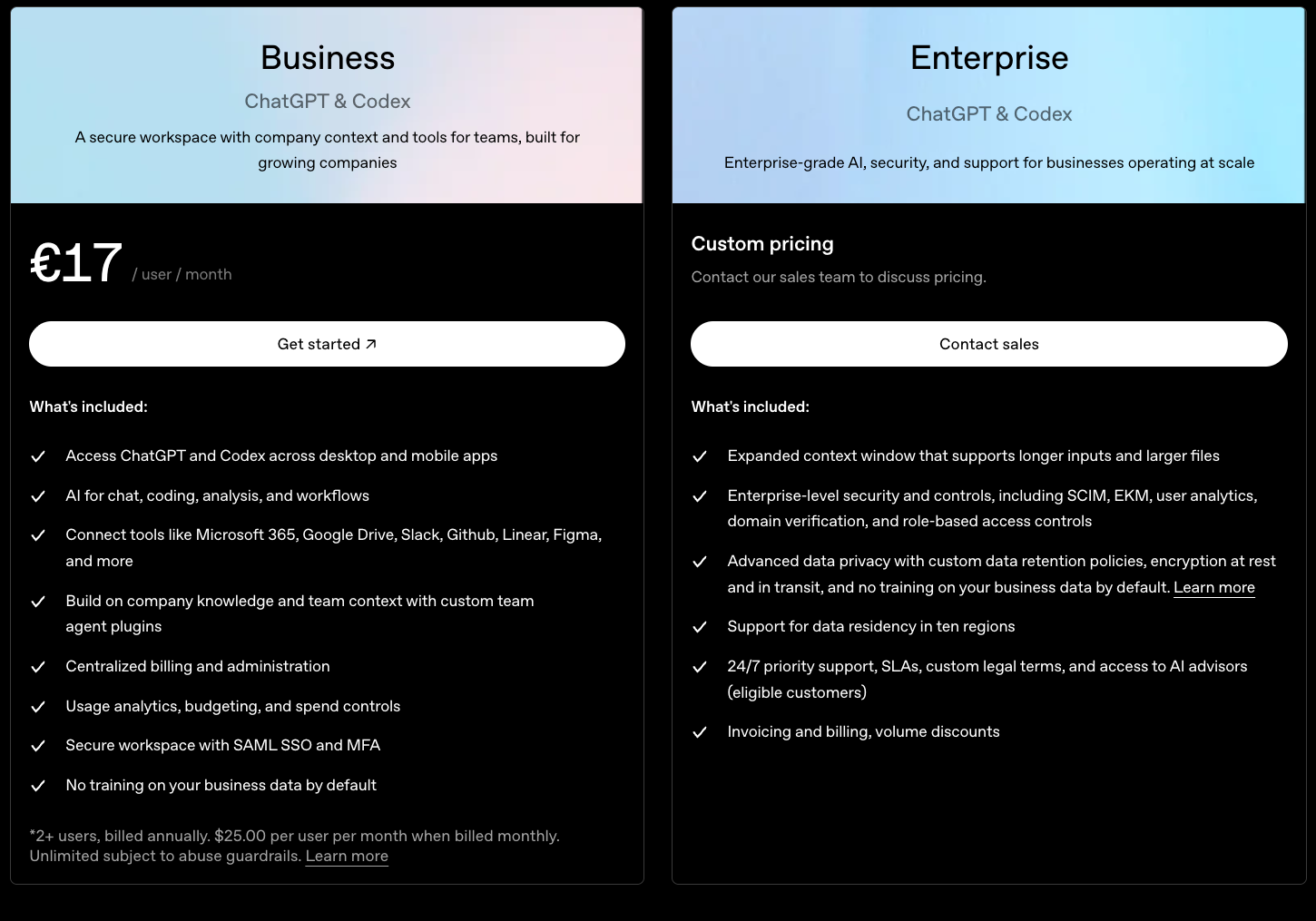
At two or more seats, ChatGPT Business often costs the same per person as Plus while adding governance and compliance, which is why the crossover point is lower than most teams assume. The constraining limit is context on non-reasoning models. For teams routinely working with very large documents or codebases, the window becomes the bottleneck before the per-seat price does.
OpenAI Enterprise Plan
Enterprise is custom-priced, generally aimed at organizations of roughly 150+ users, with independent estimates in the $60 to $100+ per seat range. It adds SCIM provisioning, enterprise key management, role-based access control, an analytics dashboard, IP allowlisting, data residency across the US, EU, UK, JP, CA, KR, SG, IN, AU, and UAE, a global admin console, 24/7 priority support, and custom legal terms.
For procurement teams: Enterprise is the only tier where you can negotiate around model-routing transparency, data retention, and custom SLAs. If you carry a regulated compliance posture or a data residency requirement, the negotiated terms matter more than the per-seat math.
Test multiple GPT models in the same thread.
You have the full control.
On Suprmind, you select models for your two AI Teams (three on higher plans), and every turn you pick which AI team will respond. You have the full control over who is answering your questions.
Free trial for proper GPT testing
7 days free, four leading AI providers, no credit card.
Beside ChatGPT you get Grok, Claude and Gemini in the same conversation.
The developer alternative.
Metered per token.
The API runs the same GPT models that power ChatGPT, but bills per token instead of per seat. For workloads with predictable cost-per-query, it can be far cheaper than a Plus seat. For high per-query token volume, it can be far more expensive. Pricing is per million tokens.
Source: platform.openai.com/docs/pricing, verified July 22, 2026. The “272K” figure sometimes quoted for GPT-5.4 is a pricing inflection point, not a context cap – the model runs to 1M tokens. o4-mini was retired from the ChatGPT interface in February 2026 but remains available on the API. The GPT-5.6 rows come from OpenAI’s July 9 GA announcement – the family launched with a restructured caching scheme, and GPT-5.5 has been repositioned as a fallback tier, so re-verify both at the docs before budgeting.
GPT-5.6 is now the flagship: who gets Sol, Terra, and Luna
The GPT-5.6 family reached general availability on July 9, 2026 across ChatGPT, Codex, and the API, ending the limited preview that ran from June 26. Free and Go get Terra, the mid-tier model. Plus, Pro, Business, and Enterprise can pick between Sol, Terra, and Luna, with a selectable effort level per model. On the API, Sol runs $5.00/$30.00, Terra $2.50/$15.00, and Luna $1.00/$6.00 per million input/output tokens.
If a comparison still describes GPT-5.6 as a preview you cannot buy, it is out of date. Sol replaced GPT-5.5 as OpenAI’s flagship on both ChatGPT and the API.
The API also offers three modifier tiers. Batch processing runs at 50% of standard rates with 24-hour async turnaround. Flex trades lower cost for slower responses and occasional resource unavailability. Priority is pay-as-you-go at 2.5x standard rates for guaranteed throughput.
The cheapest model is
50x cheaper than the flagship.
GPT-4.1 nano at $0.10 per million input tokens is 50x cheaper than GPT-5.6 Sol at $5.00. GPT-4o mini at $0.15 lands at 33x. On output the gap is wider still. For workloads that do not need flagship capability, the small models are the cost-efficient default, and the ratio is larger now than it was three months ago because the nano tier keeps getting cheaper.
When does the cheap model win? High-volume routine work: classification, extraction from structured data, content moderation, simple summarization, anything you can verify with rules rather than trust. The hallucination profile matters less when the task is constrained. GPT-4o mini’s Vectara old-dataset hallucination rate of 1.7% is lower than GPT-5’s rate above 10% on the harder Vectara new dataset. For narrow workloads, the smaller cheaper model is often the safer choice too.
The case for paying 50x more: open-domain reasoning, multi-step planning, agentic computer use, long-context recall, and any work where the question itself changes shape during the conversation. Flagship capability earns the price. Routine work does not.
Cached input costs
90% less.
Cached inputs cost 90% less than fresh inputs across the GPT-5.x family. GPT-5.5 cached input is $0.50 per million versus $5.00 fresh. GPT-5.4 cached is $0.25 versus $2.50. Caching applies when a request reuses a substantial portion of a recent prior request’s prompt, and the API caches frequently used prefixes automatically. The GPT-5.6 family launched with a restructured caching scheme, so pull its cache rates from the docs directly.
Workflows that benefit most: agentic loops with consistent system prompts, RAG pipelines reusing the same document context, support bots with stable persona instructions, any production workload with templated prompts. If your spend is dominated by input tokens and your prompts carry stable prefixes, caching is the single largest lever for cost control, with no engineering work beyond structuring the prompt.
The pace is the point.
Fifteen material pricing or model changes in the twelve months to July 2026, seven of them in the last 90 days. Any comparison built today needs re-verification before a decision over $1,000 a month. That volatility is exactly why a single-model view is fragile: the model behind your seat can change without notice, and so can what it costs.
You have compared ChatGPT on paper.
Now compare it with other three AIs, for free.
Ask one question. ChatGPT answers, and so do Grok, Claude and Gemini, in the same thread, reading each other and correcting what does not hold.
Only want ChatGPT? Switch the other three off and talk to ChatGPT alone.
7-day free trial, no credit card needed.
Availability, and
the Italy precedent.
ChatGPT is available in most countries. Sanctioned jurisdictions (Iran, North Korea, Cuba, and in some cases Russia) are blocked under US export-control compliance. Mainland China is unavailable. The UK, EU, and most of Asia and Latin America have access.
The Italian data protection authority temporarily banned ChatGPT in March 2023 over GDPR concerns. OpenAI complied within the deadline by adding privacy disclosures, age verification, and a training opt-out tool, and service was restored in May 2023 without a formal fine. The episode established that EU data protection authorities can act against AI systems without waiting for EU AI Act enforcement, which is a procurement risk to factor into European deployments at scale.
For Enterprise customers, OpenAI offers data residency in the US, EU, UK, JP, CA, KR, SG, IN, AU, and UAE. If you have a regulatory obligation to keep data in a specific jurisdiction, Enterprise is the tier where that becomes negotiable.
FAQ
ChatGPT Pricing: Frequently Asked Questions
Is ChatGPT free in 2026?
Yes. The Free tier at $0 provides GPT-5.6 Terra, roughly 10 messages per 5-hour window, and a 16K non-reasoning context window. US Free users have seen ads since February 9, 2026. GPT-5.6 Sol, Deep Research, Advanced Voice Mode, Agent Mode, and Sora require a paid plan. Codex Mobile is available free as a preview on every tier, including Free.
How much does ChatGPT Plus cost and is it worth it?
Plus is $20 per month and is the entry tier most users should choose. It removes ads, moves you up to GPT-5.6 Sol, and includes Advanced Voice Mode, 10 Deep Research queries per month, Agent Mode, Canvas, Tasks, Sora, and Custom GPT creation. Plus is monthly-only – there is no annual discount, and the $48-per-year figure that once circulated was never a standard published rate.
What is the difference between Pro $100 and Pro $200?
Both include the full GPT-5.6 family and the same core features, including the US Personal Finance preview. Pro $100 gives 5x Plus message limits and 5x Plus Codex usage. Pro $200 gives 20x Plus limits, 1M-token context, and unlimited Sora. The launch 10x Codex promotion on Pro $100 ended May 31, 2026. The difference now is rate-limit headroom, not features.
What is the ChatGPT Go plan?
Go is an $8 per month plan launched globally on January 16, 2026 after an August 2025 India-only debut. It runs GPT-5.6 Terra at capped message limits, and provides roughly 10x Free limits across messages, uploads, and image creation. Go still shows ads despite being a paid plan.
What’s the ChatGPT Business price, and what changed?
Business plan is $20 per seat on annual billing, or $25 monthly, with a two-seat minimum. On April 2, 2026 OpenAI cut both prices by $5 from the old $25 annual and $30 monthly. ChatGPT Business runs the GPT-5.6 family and includes SAML SSO, SOC 2 Type 2, ISO 27001/17/18/27701, no model training on your data, the Codex agent, and 60+ connectors. Nonprofits qualify for a substantial discount.
What is the difference between ChatGPT Business and Enterprise?
Business is $20/seat annual ($25 monthly) with a two-seat minimum, and now includes ISO 27001 compliance. Enterprise is custom-priced, generally aimed at organizations of roughly 150+ users, and adds SCIM provisioning, enterprise key management, RBAC, data residency across 10 regions, a global admin console, and custom legal terms. Independent Enterprise estimates land at $60 to $100+ per seat per month.
Why does ChatGPT show only Instant, Thinking, and Pro instead of model names?
Those labels were the pre-July-2026 picker. Since the GPT-5.6 rollout on July 9, paid tiers pick Sol, Terra, or Luna directly and set an effort level. In Auto mode the underlying variant is still chosen for you, and to verify which model handled a query you still have to open the Configure setting. API users always receive the specific model ID in response metadata, which is one reason the API is the surface to use when the model version matters to your decision.
Are there annual discounts on consumer ChatGPT tiers?
No. Plus, Pro $100, and Pro $200 are all monthly-only. ChatGPT Business is the tier with a published annual discount, at $20 per seat annual versus $25 monthly. Enterprise is annual and custom. If you see a Plus annual rate quoted, treat it as a lapsed or region-specific promotion rather than a current option.
Does ChatGPT Pro still include Sora video generation?
Yes. Sora web and app were briefly discontinued on April 26, 2026, then restored as a feature on paid tiers. Plus includes Sora at preview limits, and Pro $200 includes unlimited Sora. The standalone Sora API is a separate track and is scheduled to sunset on September 24, 2026. Earlier guidance that treated Sora as deprecated no longer holds for paid subscribers.
How does GPT-5.6 API pricing compare to other models?
The flagship GPT-5.6 Sol is $5.00 per million input tokens and $30.00 output, with Terra at $2.50/$15.00 and Luna at $1.00/$6.00. GPT-5.5 and GPT-5.5 Pro stay available as fallback tiers. At the low end, GPT-4.1 nano is $0.10 input, roughly 50x cheaper than Sol. For high-volume routine work, the nano and mini models are the cost-efficient default.
What is GPT-5.6, and which plans include it?
GPT-5.6 (Sol, Terra, and Luna) reached general availability on July 9, 2026 after a two-week limited preview. Free and Go get Terra. Plus, Pro, Business, and Enterprise get all three models with selectable effort levels. On the API, Sol is $5/$30 per million tokens, Terra $2.50/$15, and Luna $1/$6. Sol replaced GPT-5.5 as OpenAI’s flagship.
What is cached input pricing and how do I use it?
Cached input costs 90% less than fresh input across the GPT-5.x family. The API automatically caches frequently used prompt prefixes when a request reuses substantial portions of recent prior prompts. For workflows with stable system prompts or templated requests, caching is a large cost reduction with no engineering work beyond structuring the prompt.
How often does ChatGPT pricing change?
ChatGPT pricing and model availability changed roughly fifteen times in the twelve months to July 2026, seven of them in the last 90 days. Any pricing comparison built today should be re-verified before a sustained spending commitment over $1,000 a month.
How much is ChatGPT Premium?
There is no OpenAI plan called ChatGPT Premium. People who search for it almost always mean ChatGPT Plus, which costs $20 per month, or the ChatGPT Pro tiers at $100 and $200 per month. If a site quotes a “ChatGPT Premium price,” treat it as Plus pricing unless it explicitly names Pro.
What ChatGPT subscription plans are available?
Seven: Free at $0, Go at $8/month, Plus at $20/month, Pro at $100/month, Pro at $200/month, Business at $20 per seat on annual billing ($25 monthly), and Enterprise at custom pricing. The two Pro tiers share a name but differ on message limits, context window, and Sora allowance.
How much is a ChatGPT subscription per month?
Individual subscriptions run $8 (Go), $20 (Plus), and $100 or $200 (Pro). Teams pay $20 per seat per month on annual billing for ChatGPT Business, or $25 month-to-month. The free tier stays $0, with ads in the US.
Does ChatGPT offer a free trial?
OpenAI runs no public free trial of Plus or Pro, only limited referral and promotional invites. The Free tier is the de facto trial. If you want to test ChatGPT’s paid-tier models properly before subscribing, Suprmind offers a 7-day free trial with no credit card, and it runs GPT in the same conversation as Grok, Claude, and Gemini so you can see how its answers hold up.
Is ChatGPT pricing the same as OpenAI pricing?
For consumer subscriptions, yes. ChatGPT prices are OpenAI’s prices, from the free version up to Enterprise. “OpenAI pricing” can also refer to the separate API price list, which bills per million tokens rather than per seat and is covered in the rate table on this page.
Sources
- openai.com/chatgpt/pricing and chatgpt.com/pricing (consumer pricing)
- platform.openai.com/docs/pricing (API pricing)
- openai.com/index (model launch and product announcements)
- Suprmind Multi-Model Divergence Index (catch ratio data)
- Suprmind AI Hallucination Rates and Benchmarks (per-model hallucination data)
Last verified July 22, 2026. ChatGPT pricing changes more often than any other AI product – confirm at openai.com/chatgpt/pricing before making decisions.
Stop reading about ChatGPT.
Go ask it something.
Seven days free on Suprmind. No credit card. ChatGPT answers in the same conversation as Grok, Claude and Gemini,
and when one of them hallucinates something up, the others catch it before it reaches your decision.
7-day free trial. All four AI models.
No credit card required.
Disagreement is the feature.
Last verified July 22, 2026. Next refresh due August 22, 2026.