
Single-model answers look confident right up until a missed citation or untested assumption slips into a brief your team signs off on. One model’s blind spots become your liability when decisions carry legal, financial, or reputational weight. Orchestration solutions exist to change that dynamic by coordinating multiple AI models in structured flows that surface disagreement, test claims, and track why a conclusion was reached.
This guide covers the core modes – sequential, fusion, debate, red team, and research symphony – along with adjudication mechanics, persistent context, and a practical decision framework for choosing the right approach. The examples draw from hands-on orchestration of GPT, Claude, Gemini, Grok, and Perplexity across legal, investment, and research workflows.
What Orchestration Solutions Are – and What They Are Not
AI orchestration is the structured coordination of multiple language models across a defined workflow, with explicit routing, synthesis, and validation steps. It is not simply calling two models and averaging their answers. The distinction matters because naive parallelism without adjudication can amplify errors rather than catch them.
Orchestration is also different from:
- RAG (retrieval-augmented generation) – which adds documents to a single model’s context but does not validate outputs across models
- Fine-tuning – which adapts one model’s weights for a domain but cannot resolve internal contradictions or test its own claims
- Agent frameworks – which automate tool use and task delegation but often lack structured cross-model validation
The core building blocks of a real orchestration solution are:
- Routing – directing subtasks to the model best suited for them
- Parallelism – running models simultaneously to gather diverse outputs
- Consensus and adjudication – comparing outputs, flagging contradictions, and resolving conflicts with evidence
- Persistent shared context – keeping all models aligned on the same facts, sources, and prior decisions
- Auditability – logging inputs, outputs, disagreements, and resolution rationale for governance and review
When Orchestration Is Worth the Overhead
Orchestration adds latency and cost. It is not the right tool for every task. Use it when the cost of a wrong answer exceeds the cost of the extra compute and review time.
Orchestration is warranted when:
- The output will inform a legal, financial, or compliance decision
- The task requires synthesizing conflicting sources or interpretations
- A single model’s blind spots are likely to go undetected without a challenger
- The work needs an audit trail for regulatory or team review purposes
- Reproducibility across projects and teams is a requirement
For low-stakes drafting, simple Q&A, or well-bounded tasks with clear ground truth, a single capable model is usually faster and sufficient.
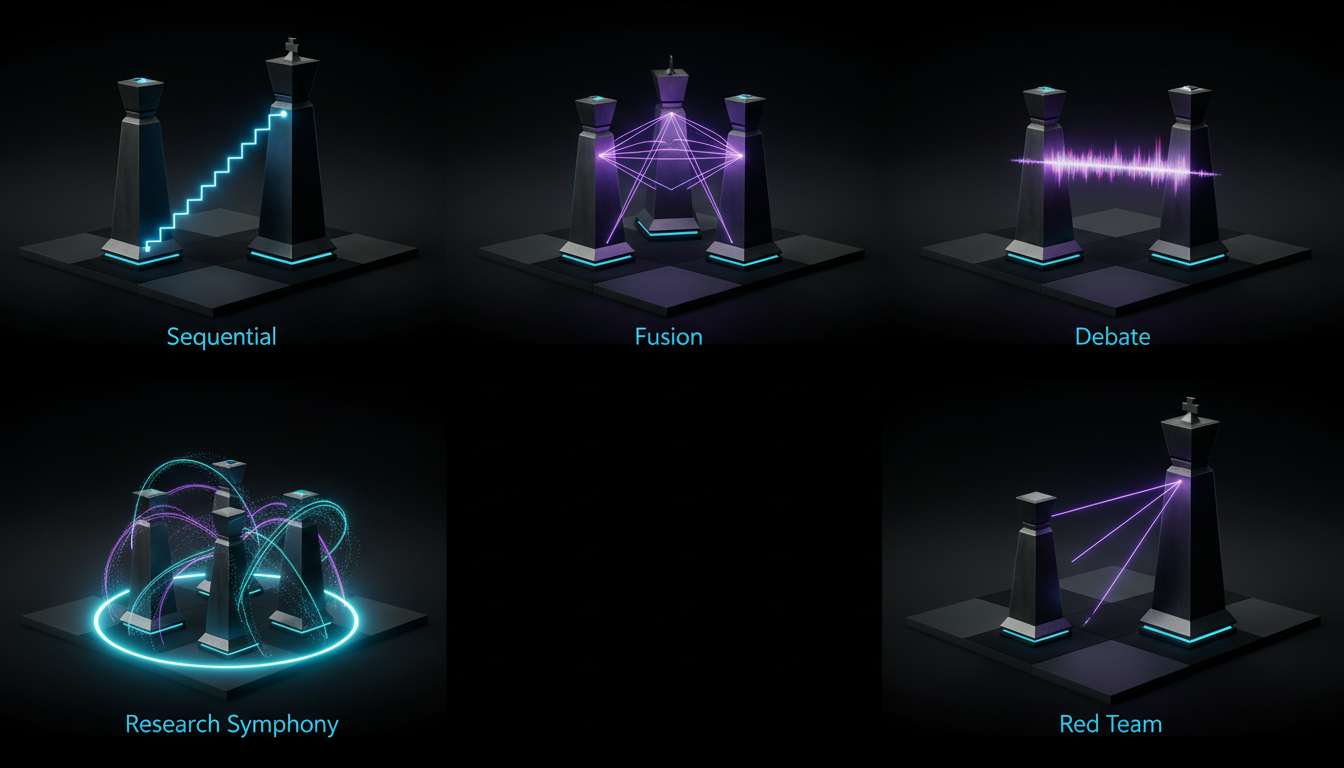
The Five Core Orchestration Modes
Choosing the wrong mode is one of the most common implementation mistakes. Each mode fits a different risk profile and task structure. Here is a breakdown of each, with selection criteria and a concrete workflow example.
Sequential Mode – Progressive Depth and Error-Catching
Sequential mode pipelines a task through multiple models in order, where each model builds on the prior output. This works well when the task has natural stages that require different strengths, and when catching errors before they compound is worth the added steps.
A typical investment memo workflow in sequential mode runs like this:
- Model A extracts structured data from source documents
- Model B drafts bull and bear cases using that structured data
- Model C reviews the draft for logical gaps and unsupported claims
- The Adjudicator flags unresolved contradictions before final output
The failure mode to watch for: if an error enters early in the chain, downstream models may accept it without challenge. Build in explicit validation checkpoints between stages rather than trusting the chain to self-correct.
Super Mind mode – Parallel Synthesis for Breadth and Speed
Super Mind mode (also called Supermind mode) runs multiple models simultaneously against the same prompt, then synthesizes their outputs into a single response. It trades sequential depth for parallel breadth. You can explore Super Mind and Debate modes in detail to see how synthesis weighting works in practice.
This mode fits tasks where:
- Speed matters and you need broad coverage fast
- No single model has a clear edge on the topic
- You want to surface the union of what multiple models know rather than one model’s take
A market landscaping task benefits from fusion because different models have different training emphases. The synthesis step weights contributions by evidence quality, not by which model responded fastest.
The failure mode: fusion without strong synthesis criteria produces blended outputs that smooth over real disagreements rather than surfacing them. Set explicit conflict-flagging rules before synthesis runs.
Debate Mode – Surfacing Assumptions and Contradictions
Debate mode assigns explicit positions to different models, runs structured argument exchanges, and then adjudicates. It is the right choice when the cost of a missed assumption is high and you want the AI system to challenge itself before you review the output.
Watch this video about orchestration solutions:
A legal clause interpretation workflow in debate mode:
- Model A argues the clause favors the counterparty
- Model B argues the clause favors your client
- Models exchange one or two rounds of challenge and rebuttal
- The Adjudicator synthesizes the strongest arguments from each side with citations
- The final output flags residual uncertainty and notes which interpretations lacked supporting precedent
Debate mode is not about picking a winner. It is about forcing the system to articulate and test the assumptions behind each position before a human reviewer sees the output.
Red Team Mode – Adversarial Stress-Testing
Red Team mode assigns one or more models the explicit role of adversarial challenger. Rather than building on prior outputs, red team models attack them – looking for edge cases, logical failures, unsupported claims, and implementation risks. You can see the full mechanics in the Red Team mode documentation.
A risk assessment workflow using red team mode:
- A primary model proposes a control or mitigation strategy
- Red team models generate multiple failure scenarios for that control
- Each failure scenario is evaluated for likelihood and severity
- The Adjudicator ranks unaddressed risks and flags them for human review
Red team mode is particularly valuable before sign-off on high-stakes recommendations. It catches the class of errors that a model will not catch in its own output because it lacks the adversarial framing to look for them.
Research Symphony – Multi-Stage Research Synthesis
Research Symphony is a structured multi-stage workflow: scoping, gathering, synthesis, and validation. It is built for tasks that require comprehensive coverage, source tracking, and deduplication across a large body of material.
An academic literature review in Research Symphony mode:
- Scoping stage – define the research question and inclusion criteria
- Gathering stage – multiple models retrieve and summarize relevant sources in parallel
- Synthesis stage – outputs are merged, duplicates removed, and conflicting findings flagged
- Validation stage – the Adjudicator checks citations and flags claims without source support
The result is a structured synthesis with a traceable source map rather than a single model’s summary of what it recalls from training data.
The Adjudicator – How Conflict Resolution Actually Works
Every orchestration mode eventually produces disagreement between models. The Adjudicator is the component that resolves those conflicts with evidence rather than averaging or deferring to the most confident-sounding output. You can see the Adjudicator in action through Suprmind’s Adjudicator feature, which handles multi-LLM conflict resolution in live workflows.
The adjudication flow works like this:
- Collect all model outputs and flag points of disagreement
- Request supporting citations or reasoning from each model for contested claims
- Score each claim by evidence quality and internal consistency
- Produce a resolution that notes which claims were accepted, which were rejected, and why
- Log the full adjudication trail for audit and review
AI hallucination mitigation through adjudication is more reliable than relying on a single model’s self-assessment of its own confidence. When models disagree, that disagreement is itself a signal. When they agree on a claim without supporting citations, the Adjudicator flags it rather than treating consensus as proof. Read more about how this works in Suprmind’s AI hallucination mitigation approach.
Persistent Context – Why Context Fabric and Knowledge Graph Matter
One of the most underappreciated failure points in multi-model workflows is context drift. When each model works from its own ephemeral context, they can reach different conclusions not because they reason differently but because they are working from different information.
Context Fabric solves this by maintaining a shared context layer that all models in a session access simultaneously. Every model sees the same sources, the same prior decisions, and the same flagged uncertainties. This prevents a class of errors where two models appear to agree because they are both missing the same piece of information.
The Knowledge Graph adds structured retention on top of that shared context. Key entities, relationships, and decisions are stored in a queryable structure rather than buried in conversation history. This matters for:
- Long-running projects where context windows would otherwise truncate earlier work
- Cross-session continuity when a workflow spans multiple days or team members
- Governance requirements where decisions need to be traceable to specific sources
Scribe – Living Documentation for Audit Trails
Scribe is the living document that evolves with the orchestration session in real time. It captures inputs, model outputs, disagreements, adjudication decisions, and source citations as the workflow runs. This is not a post-hoc export. It is a concurrent record.
For compliance-sensitive workflows – legal review, investment analysis, regulatory submissions – Scribe provides the audit trail that proves what information was available, what was contested, and what rationale drove the final output. This is the governance layer that turns multi-model orchestration from a productivity tool into a defensible professional process.
Note: Content referencing legal or compliance workflows is for illustrative purposes only and does not constitute legal advice.
Suprmind’s AI Boardroom – Orchestration in Practice
The 5-Model AI Boardroom runs GPT, Claude, Gemini, Grok, and Perplexity in a single thread with shared context, structured modes, and adjudication built in. Rather than switching between tools or copying outputs between tabs, all five models work from the same prompt and the same context simultaneously.
The Boardroom supports all five orchestration modes described above. You can switch modes mid-session based on what the task requires – start with fusion for broad coverage, shift to debate when a contested claim needs stress-testing, and close with red team before sign-off. The Suprmind platform overview covers the full range of capabilities and how they connect.
Watch this video about agentic ai orchestration:
Targeted Mode and Model Routing
Targeted mode lets you direct specific subtasks to specific models using @mentions within a session. When you know that one model has stronger reasoning on a particular domain, or that another has more current training data on a topic, you route accordingly rather than running all five models on every subtask.
Model routing decisions in targeted mode are based on task type, not habit. The practical routing heuristics are:
- Use models with stronger reasoning chains for logical analysis and argument evaluation
- Use models with broader training coverage for market or literature scans
- Use models with stronger code generation for technical implementation subtasks
- Use the Adjudicator to resolve any conflicts between routed outputs before synthesis
Implementing Your First Orchestrated Workflow
The minimal viable orchestration setup does not require all five modes at once. Start with the mode that matches your highest-risk current task and build from there.
Pre-Flight Checklist for Any Orchestration Run
- Define task decomposition – break the task into stages or subtasks with clear outputs for each
- Assign model roles – decide which models handle which stages or positions
- Pick the mode – sequential for staged depth, fusion for breadth, debate for contested claims, red team for adversarial testing, Research Symphony for comprehensive research
- Set adjudication criteria – specify what counts as a conflict and what evidence standard resolves it
- Persist shared context – load all relevant sources and prior decisions into Context Fabric before the session starts
- Log to Scribe – confirm the living document is capturing the session for audit and reuse
Measuring Whether Orchestration Is Working
Orchestration adds process overhead. Track these metrics to confirm it is paying off:
- Disagreement rate – how often do models produce conflicting outputs on the same claim? Rising disagreement on a topic is a signal the task is genuinely ambiguous and needs human review.
- Correction rate – how often does the Adjudicator or a human reviewer overturn an initial model output? High correction rates indicate the orchestration is catching real errors.
- Confidence score – after adjudication, what proportion of claims have supporting citations vs. flagged uncertainty?
- Review time saved – compare time spent reviewing orchestrated outputs against single-model outputs for the same task type.
If disagreement rates are consistently near zero, either the task is genuinely unambiguous or the models are not being challenged enough. If correction rates are near zero, the adjudication criteria may be too permissive.
Frequently Asked Questions
What is the difference between orchestration solutions and a standard multi-agent framework?
Multi-agent frameworks focus on task delegation and tool use across autonomous agents. Orchestration solutions add structured cross-model validation, adjudication, and persistent shared context on top of that delegation layer. The key distinction is whether the system can surface and resolve disagreement between models, not just divide work between them.
How does adjudication differ from just picking the majority answer?
Majority voting treats all model outputs as equal and ignores the quality of supporting evidence. Adjudication evaluates each model’s claim against citations, internal consistency, and stated reasoning before resolving a conflict. A well-supported minority position can and should override an unsupported majority consensus.
When should I use Debate mode vs. Red Team mode?
Use Debate mode when you want to explore competing interpretations of the same evidence – both sides are working from the same facts. Use Red Team mode when you want to stress-test a specific proposal or recommendation by having models actively try to break it with adversarial scenarios and edge cases.
Does running five models simultaneously make outputs five times more expensive?
Super Mind model runs do increase compute cost relative to a single model call. The relevant comparison is the cost of the compute versus the cost of an error in a high-stakes output. For tasks where a single missed claim could result in legal exposure or a flawed investment decision, the cost trade-off typically favors orchestration.
What is Context Fabric and why does it matter for long projects?
Context Fabric maintains a shared context layer that all models in a session access simultaneously. Without it, models in a multi-model workflow can drift apart because they are working from different subsets of available information. For projects spanning multiple sessions or team members, Context Fabric prevents decisions from being made on stale or incomplete context.
How do I know which orchestration mode to start with?
Start with the risk profile of your task. If the task has clear sequential stages, use sequential mode. If you need broad coverage fast, use fusion. If a claim or interpretation is genuinely contested, use debate. If you are about to sign off on a recommendation, run red team first. Research Symphony fits comprehensive research tasks with source tracking requirements.
Turning Model Diversity Into Decision Confidence
Orchestration is a reliability system, not a complexity upgrade. The goal is structured disagreement, adjudication with evidence, and persistent context that keeps all models aligned – so that by the time output reaches a human reviewer, the obvious errors have already been caught and the residual uncertainty is clearly labeled.
The practical path forward:
- Pick the mode that matches your current highest-risk task type
- Set explicit adjudication criteria before the session starts
- Measure disagreement and correction rates to confirm the process is catching real errors
- Persist decisions in Scribe for governance and future reuse
With the right mode and controls in place, multiple models stop being a coordination problem and start being a cross-validation system. See how this works across all five models in the 5-Model AI Boardroom, and explore the full platform to build your first orchestrated workflow.